
Short Fiction (Part 1)

Personal statements, composition exams, metaphorical scars in The Kite Runner, hooks followed by the thesis statement, and evidence followed by commentaries made us want to pause from strategy and focus more on freedom. After all, writing is an artistic expression.

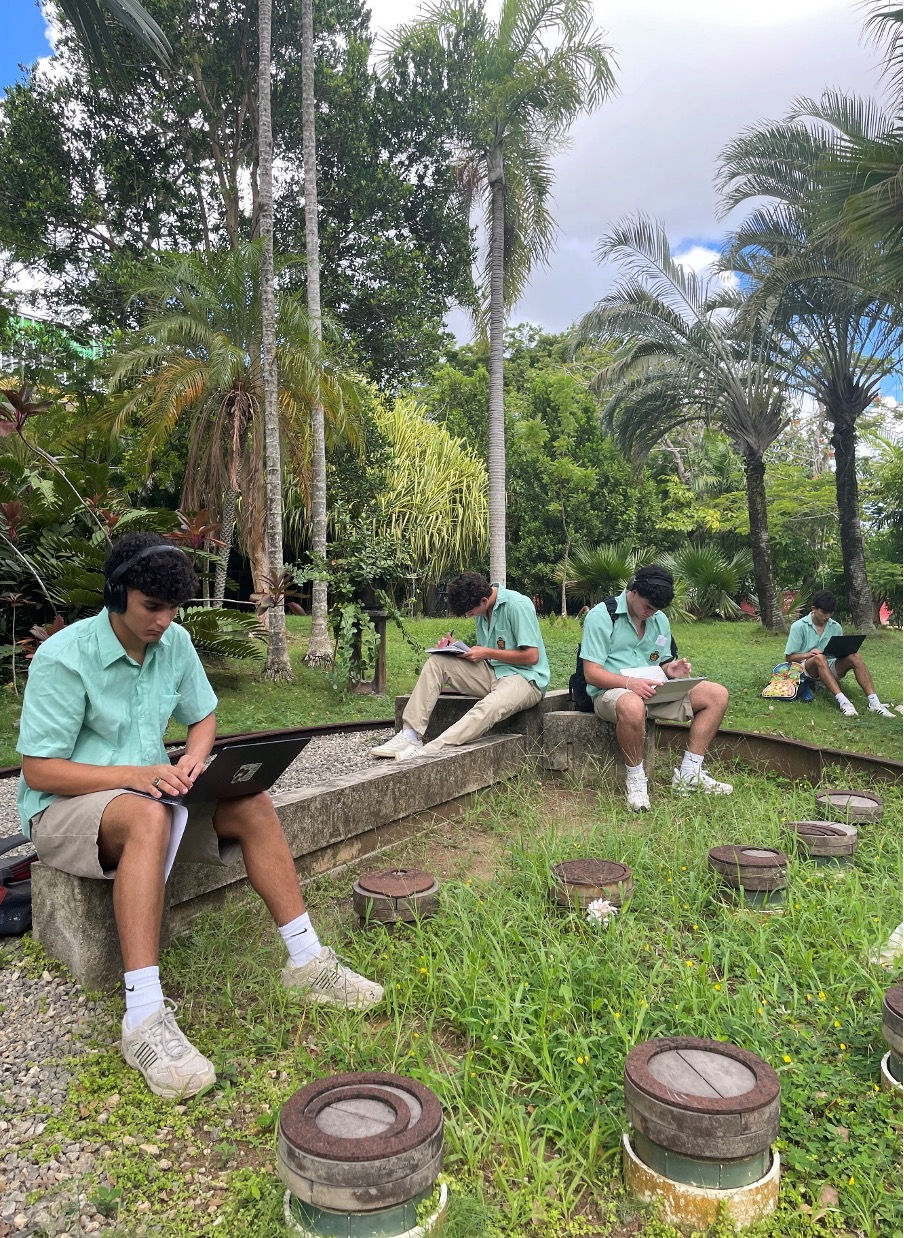
Seniors from the AP English Literature & Composition course trusted their own creative process required to develop original short stories. We also visited the Jesuit Garden in search of both peace of mind and inspiration.
“Teacher, I thought this was free writing. Why do we need a rubric?”
“The rubric will purposely help you shape your freedom of thought.”
Narrative structure, writing quality, characterization, setting, creativity, originality, and emotional resonance were the criteria guiding students by examples to find the muse and conceive their ideas. Therefore, short fiction found a new place to rest in imagination.
“The Sound of Tomorrow”
by Jorge Ruiz Padró

The businessman walked slowly along what had once been known simply as the Expreso Baldorioty. He had walked this road hundreds of times before, but this time, something was different.
The concrete and traffic that he remembered had been transformed. Trees lined the sidewalks, and green spaces separated pedestrians from the highway. Small parks were filled with families, children, and older people sitting beneath the shade. New public plazas connected restaurants, cafés, and small Puerto Rican businesses.
Security towers stood at several points along the walkway, and police officers could be seen patrolling the area. For once, the city seemed designed not only for cars, but for the people who lived in it.
He stopped beside the walkway and looked around.
A group of teenagers passed him on bicycles. A couple of tourists rode electric scooters while taking pictures of the city. Nearby, a Puerto Rican family sat together on a bench, sharing food from a small local restaurant.
The businessman smiled.
He had traveled to Madrid several times for work, and suddenly the comparison came to mind.
It almost looks like Madrid.
But this was not Madrid.
This was San Juan.
This was Puerto Rico.
And somehow, it looked like the Puerto Rico he had always imagined. Then he heard a sound.
Whoosh! A train passed above him.
The Tren Urbano moved smoothly along its expanded route, powered by electricity. Its cars were quiet and modern, carrying hundreds of passengers toward the airport and back into the city.
The businessman watched it disappear into the distance.
For years, people had talked about connecting Puerto Rico better. Now he was watching it happen in front of him.
The train turned in the distance and began its return trip.
Back and forth.
Back and forth.
A moving symbol of a city that no longer felt stuck in place.
His phone suddenly rang so he looked at the screen, and it was his wife.
“Where are you?” she asked.
“I’m almost at the airport,” he replied. “How is the zoo?”
“It is unbelievable,” she said.
He could hear the noise of the crowd behind her.
She was with their three children at the newly opened zoo inside Parque Luis Muñoz Rivera, near Puente Los Hermanos. The renovated park had become one of the biggest family attractions in the area, with animals from Puerto Rico and from different parts of the world.
“Dad!” one of his children shouted through the phone.
The businessman laughed.
“What are you doing?”
“Waiting in line!” his wife answered.
“How long?”
She laughed. “Thousands of people are here. The line goes almost all the way to El Hamburgerito!”
He shook his head. “Thousands?”
“Thousands,” she repeated. “Families, tourists, everyone. The whole park is packed.”
He looked around at the city again.
Maybe this was what Puerto Rico needed —not one giant project, but hundreds of improvements that made everyday life feel different.
His wife continued. “And they were talking about the new desalination plant near Old San Juan. They are expanding the water system and modernizing the infrastructure.”
“That sounds promising,” he said.
“Everything feels different,” she replied. “People actually seem excited about the future.”
He remained silent for a second. The word stayed in his mind: “Future.”
He had spent years building his restaurant, but lately he had begun thinking beyond his own business. He wanted to know what kind of place he was building it in.
A business could open a new location.
A city could build a new park.
A government could expand a train.
But none of that mattered if people did not believe Puerto Rico could become something more.
He checked his watch.
“I have to go. I’m almost at the innovation district.”
“Okay,” his wife said. “We’ll take the train and meet you there.”
The call ended, and he continued walking. Soon, the landscape changed again: Ahead of him was the new innovation district near the airport, filled with offices, restaurants, technology companies, and local entrepreneurs. And right in the middle of it stood his newest project: El Smacheo.
What had started as a small American-style smash burger restaurant had grown into a local business with several locations across the metropolitan area.
Today was the opening of his newest restaurant.
As he approached the entrance, he saw nearly one hundred people gathered outside.
Government officials stood beside business owners. Employees moved around preparing for the ceremony. Families waited near the entrance, while journalists and local media recorded the event.
A large ribbon stretched across the front doors. He looked at his restaurant and then at the people standing in front of it. He felt proud, but his pride was not only because of the restaurant, it was because of everything surrounding it.
People had transportation to get there.
Families had parks where they could spend time together.
Tourists had places to visit.
Local businesses had new customers.
The city had invested in spaces where people could gather.
For once, growth did not feel like something happening somewhere else. It felt like it was happening here in Puerto Rico.
A train could connect people to opportunity.
A park could give a neighborhood a place to breathe.
A small business could grow into a larger company.
And one successful idea could inspire another.
Then he heard a familiar sound: the train. He looked toward the station. The doors opened, and his wife stepped onto the platform with their three children. They had traveled from the zoo near Old San Juan all the way to the airport district by train.
His youngest child ran toward him. “Dad!”
His wife smiled. He bent down and hugged him, “You made it.”
“I made it,” he said.
The crowd began to applaud as the businessman stepped toward the microphone. He looked at the restaurant, then at his family, then at the people standing in front of him.
He took a breath. “Today,” he began, “we are opening more than a restaurant.”
The crowd became quiet.
“We are opening a door.” He looked around. “A door to new businesses. A door to new jobs. A door to better transportation. A door to more public spaces, more opportunities, and a better quality of life.”
He paused.
“And maybe, most importantly, a door to believing that Puerto Rico can build something for itself.”
He prepared to continue. Then —BOOM! A massive sound shook the building.
The lights disappeared.
The crowd disappeared.
His family disappeared.
The train disappeared.
The parks disappeared.
The green spaces disappeared.
The innovation district disappeared.
Everything went black.
The businessman opened his eyes. He stared at the ceiling, and for several seconds, he did not move. Then, he heard the familiar sound of cars outside.
He sat up.
His room was dark.
He reached for his phone: 2026.
He walked toward the window, and outside, the Baldorioty was filled with traffic. Cars barely moved. There was no expanded train running toward the airport, no new parks lined the highway, no green spaces replaced the concrete, no crowds were waiting outside his new restaurant.
And El Smacheo?
It was still waiting for the permits and approvals necessary for its expansion.
He stood there silently. The dream had been so real that waking up felt like losing something. He thought about the train.
The parks.
The families.
The businesses.
The tourists.
The clean energy.
The water system.
The innovation district.
His children running toward him.
His wife stepping off the train.
The crowd applauding.
All of it had been imaginary, but one question remained. Why did it feel so possible?
He looked out the window again.
Puerto Rico was not the island he had seen in his dream —not yet. But the dream had shown him something important: A future does not appear by itself. Someone has to imagine it. Someone has to build it. Someone has to decide that what exists today does not have to be what exists tomorrow.
He picked up his phone and opened the folder containing his business plans. Then he opened a blank page. At the top, he wrote two words: “The Future.”
He stopped for a moment. Below those words, he wrote: “Puerto Rico can have a future.” He looked at the sentence. Then he added one final line:
“We just don't know when.”
The End

“How Long?”
by Juan José Puras Bibiloni

David woke up to a morning so beautiful it irritated him.
Sunlight poured through the curved windows of his New York apartment, turning the neighboring towers gold. His floor was high enough to give him a sweeping view of the city, but low enough that he could still see people in the windows across the street. It made him feel like a part of New York. David would have preferred to feel above it.
Soon, he told himself, he would be.
Inside the black suitcase beside his bed was a device that could capture time. His colleagues had called his research impossible, then reckless, then dangerous. They said it was too soon that not enough tests had been done. Today, against their bickering, he would demonstrate it at the lab. After that, they could choose their words more carefully, he thought.
He rose from his cashmere sheets and made the bed as neatly as it had looked in the showroom. He brewed a strong, dark coffee and, for once, carried it across the kitchen without spilling a drop. His best suit lay folded where he had left it the night before. Everything was in its place.
That bothered him more than he cared to admit.
He went back to the window. The streets seemed unusually quiet compared to the usual bustling noises of honking and early New Yorker disputes. He leaned closer, trying to make out the traffic below, when the building’s fire alarm began to shriek.
“Of all mornings,” he muttered.
David took the stairs with his suitcase in hand. He met no one on the way down. The lobby was empty, and the doorman had abandoned his post. Perhaps everyone had already gone outside. David had no intention of staying to find out.
His car waited at the curb.
He expected his daily salutation from his driver Wilberto, but no “Good morning” reached his ears. No matter.
David didn’t acknowledge him, as he had done each day before with an unsettling consistency which would be apparent to any more caring a man. He set the suitcase beside his feet and opened his phone. The time was 9:57AM.
He started rehearsing what he would say when he unveiled the device. Outside the tinted window, the city slipped past unnoticed.
Then came the sound of brakes, a violent jolt, and the crack of glass inside his suitcase. Pain swept through him so suddenly that he had no time to understand it.
David woke in his bed.
He lay still, staring at the ceiling. Sunlight streamed through the curved windows. Beside him stood the black suitcase. He opened it with shaking hands to find that the glass casing around his device was intact.
A dream, then —an unpleasant one, but hardly worth delaying the most important day of his life. The feeling of relief overwhelmed his senses to the point that he did not notice the blinking ON light on his device.
He made the bed, brewed his coffee, and put on his suit. The fire alarm sounded. The stairwell and lobby were empty again. Wilberto’s car greeted him at the curb.
This time, David kept his eyes on the road. As usual, he didn’t fixate on the pedestrians, as he didn’t wish to stand at their same level, but there were no people to diminish. And much to his terror, when he checked his phone and saw the numbers change to 9:57AM, he heard it again. The sound of brakes, a violent jolt, and the crack of glass inside his suitcase. And again, pain swept through him so suddenly that he had no time to understand it.
David woke in his bed.
This time, he did not move, and a tear slipped down his cheek.
The device’s ON light blinked inside the suitcase. His colleagues had warned him it had never been tested outside the lab.
He tried to remember yesterday and found nothing. His head felt crowded with memories he could not reach. Had this happened twice? Twenty times? How long had he been waking in this bed before he noticed? How long…
His eyes swelled with tears like never before. He started to wish he had listened to those who had cared for him enough to warn him of the danger of his research.
He looked at the clock. 9:12.
At 9:57, the car would crash. He had forty-five minutes to stop it.
Somewhere below, the fire alarm began to shriek.
The End.
“Steady Hands”
by Rafael Esteves

The night before the attack on Fort Kessel, Eli Marsh set up his barber chair inside an old church in a French village. Half the roof had been bombed away, so you could see the stars. It smelled like dust and smoke, and broken stained glass crunched under his boots. It was nothing like his dad's barbershop back in Ohio, which smelled like aftershave and always had a baseball game on the radio. Here, the only sound was artillery booming far away.
His dad always said the most important thing a barber has is steady hands. Eli's had never shaken once in the whole war. When the Army found out he was a barber, they made him the company barber, and before every big mission, the guys lined up for haircuts. Nobody said it, but they all wanted to look decent in case something happened to them.
Everyone knew tomorrow was going to be bad. Fort Kessel was a German base of thick concrete bunkers, with machine guns pointed at a flat, muddy field. At dawn, the company had to run across it with nothing to hide behind but a few dead trees.
Danny Pruitt was next in line. He was eighteen, the youngest guy in the company, and kind of proud of his curly hair. He sat down and pulled a wrinkled photo out of his pocket. It was him and a girl at a county fair —his curls sticking out from under a cowboy hat. He whispered, "Eli, can you leave the top? My girlfriend loves my hair. It's how she remembers me."
Sergeant Pike was standing by the altar watching everyone. "It's regulation, Pruitt. Short hair. No exceptions."
Eli felt bad for Danny. So he snapped the scissors near Danny's ear, pretending to cut, and only trimmed a little off the back. A few small curls fell on the floor like question marks. Then, he brushed off Danny's shoulders like he was done.
It didn't work. Pike walked over and grabbed a handful of Danny's curls.
"You think I'm stupid, Marsh?"
Everyone in the line got quiet.
"No, Sergeant."
"Then cut it. Right now, in front of everybody."
Eli looked down at the scissors. It would be so easy to just cut the hair and be done with it. But he looked at Danny, who was staring at the floor, and said, "No, Sergeant."
Pike walked right in front of his face. Eli could smell the cigarettes in his breath. "You really think his hair is going to keep him alive tomorrow?"
"No," Eli said. "But it's the only thing he has left that's still his."
Pike stared at him for a long time, then let go of Danny's hair. For a second, his jaw tightened like he wanted to say something else, but no words came out of his mouth.
"Fine," Pike said. "You like being brave? Tomorrow you're in the first wave across that field. Right in front."
The guys in line looked at Eli like he was crazy. Most men in the first wave never made it to the bunkers.
Pike walked out. Eli finished the rest of the line, and his hands stayed steady the whole time, even though his heart was pounding.
The next night, Eli set up his chair again. He remembered the mud pulling at his boots, the smoke burning his throat, and the bullets hitting the dirt around him like rain. Somehow, he had made it to the bunkers even though he still didn't understand how.
Water dripped through the hole in the roof. There were no stars tonight, just gray clouds. The line was a lot shorter, and he told himself not to count, but he did anyway.
Nine guys were missing.
Eli kept looking at the altar where Sergeant Pike always stood. He wasn't there. Pike was one of the nine. The man who sent Eli to the front was dead, and Eli, who was supposed to die, was still alive. It didn't feel like winning. It made him feel worse.
Then, someone sat down in the chair. It was Danny. He had mud in his hair and a cut on his face, and he looked older somehow.
"Cut it all off," Danny said. "She'll understand. I don't want to look like the kid in that picture anymore."
Nobody was there to make him do it. Nobody was there to stop him either.
Eli picked up the scissors. It was the first time in the whole war that his hands were shaking.
The End.
“Solitude”
by Gianmarco Puig Barbarossa

I don’t know how long I’ve been here.
Season through season, person through person, all is just a blur. The same frame my whole life. The same small river. The same rocks. The same view. It used to be breathtaking, now it is a blatant reminder of my dull, porous life.
The same stream glides past the smooth stones, carrying with it the joyful distant memories of the past. Pines tower over everything everywhere whispering with the smooth wind messages I never understand. Flowers bloom and wilt. Every sunrise lights up the skies with its crimson light. It is truly beautiful, beautiful enough so that I am just a mere speck in comparison.
No one notices me. I’ve been trying to ask people for help forever, but they ignore me and pass by me as if I wasn’t there in front of them. The most they have done is sit next to me.
Loneliness – loneliness is all I feel now. No family, no friends, nothing.
Then, one cool fall day, he finally came.
He wasn’t like the rest of them. He didn’t rush past me like the others; he watched, he felt, and he listened.
He rested against me for hours and hours, quietly staring off into what has cursed me. The silence reassured me. I didn’t feel invisible anymore. He ran his hand across my mature bark and smiled —as if he could somehow understand all the pain I’ve carried for oh, so many years.
Day after day, he returned.
He would come with his food and eat under my shade, seamlessly babbling on about his life. He spoke about his childhood, his job, his dreams. I wished to answer back, but I couldn’t. I listened to every word.
The wind rustled my leaves every time he spoke. It was laughter. Finally, joy.
The days grew shorter, and the warm fall days were a thing of the past. Winter has arrived. My leaves covered the floor one by one, and while he watched what I had created, he whispered, “Fall is my favorite month.” It became my favorite month too. It was the month that brought him to my life.
Before long, the cold creeped in.
The river became slated in a thin sheet of ice. Snow rested calmly on the rocks, and the once lively forest had become silent.
One dreadful morning, I heard those familiar footsteps. Usually the highlight of my day, but this time I could tell something was different. His usual lunch was replaced by a long tool I’ve never seen before. Fear spread through me like an infectious disease when he gently placed his hand against my trunk and deeply said, “I’m sorry.”
The first swing echoed through the forest. A wave of excruciating pain enveloped me; then, the second swing, and finally, I fell.
All the pain held up in me left, and I thought maybe this was what I had needed all along.
He, on the other hand, had a face of pure sadness. I could tell this wasn’t a pleasurable experience for him.
Fallen, I couldn’t help but look around me: The one place I considered my prison cell was now where I most wanted to be.
The End.

“Little Johnny’s Perfect Sandwich”
by Miguel Bermúdez González

Little Johnny was a kid with big dreams. He lived in New York, the city of chopped cheese and the iconic bacon, egg, and cheese. His dad, Giovanni, was the owner of the most famous deli on the East Side, where the line stretched three blocks. Since he had always been surrounded by this environment, Little Johnny wanted to prove to his dad that he was capable of inheriting the family business. This didn’t occur as fast as he wanted due to the fact that Giovanni didn’t have the same opinion.
He thought that Little Johnny was unproven and reminded him, “A deli isn’t a toy, Johnny.”
As Johnny put his apron back on the hook, Giovanni said, “Come back when you’ve earned it.”
Stunned and hurt by his father's words, he decided to prove his skills in the Annual Sandwich Making Competition. Since this was such a prestigious event, he decided to go on a worldwide trip to learn all the ancient techniques needed to make the perfect sandwich.
The trip lasted one entire year. It helped him master all types of skills he needed to have a chance to win the tournament. He learned fermentation in Japan, smoke-curing in Texas (where the smoke clung to his clothes for weeks), and pickling in Seoul, his grandmother’s birthplace. When he visited her, she finally surrendered her secret recipe.
Little Johnny had kept all these recipes in an old notebook his father had passed on to him. It contained his father's basic recipes and the 11 recipes he learned —each one flawless and from a different place.
After arriving from the trip, it was finally time to put his skills to the test. The competition room smelled like fresh ingredients and ambition. Under the glaring LED lights, Johnny’s station gleamed like an operating table. All his ingredients were lined up perfectly, in order from smallest to biggest. Next to them he placed his notebook. At the back end of the room, stood his dad Giovanni, one of greats in the field and the owner of one of the most sought-after delis in New York. Workers started and ended their shifts, eating the famous bacon, egg, and cheese. Giovanni kept his typical poker face, but behind it, he was counting each one of the mistakes his son made and hoping he would not commit any.
After the competition started, Johnny wasted no time applying every recipe he learned. He finished his sandwich with 8 minutes left on the clock. Judge Bruno put on his glasses and took a small but precise bite out of Johnny’s masterpiece. He had tasted about 500 sandwiches in his career, and he knew within seconds of taking the first bite that this one was the one. He chewed slowly, without a smile. It was a brilliant but empty reaction.
“Kind of impressive,” he said. “But who made this sandwich?”
“I did,” Johnny said while his stomach nervously twisted.
“It tastes like it came from every part of the world.”
Johnny looked down at his plate. It was a perfect piece of art without its painter’s autograph. Eight minutes were still left on the clock, and the crowd’s whispers and judgements pressed on him as if the walls were moving closer every second.
He closed the old recipe notebook. Then in one split second, Johnny swept the sandwich into the trash.
Giovanni’s shoes shifted onto the tile. His face, for the first time that evening, cracked —half in horror and half in hope.
Johnny grabbed all the necessary ingredients to make his father’s iconic bacon, egg, and cheese. First the roll, then two eggs (Giovanni specifically used two), bacon, and finally a slice of American cheese. He imagined himself cooking in his childhood home.
He cooked with patience over the grill.
His hands stopped shaking.
His head was clear.
He only added one thing from his travels: a thin swipe of Seoul brine, a single note in a song he already knew.
Sadly, he did not win the tournament. The trophy went to a tall, architectural creation with a name no one in the room could pronounce. But after the award ceremony, Judge Bruno came back to Little Johnny’s workstation. For the first time that day, he looked like a customer, not a food critic.
He took off his glasses and asked, “May I have another?”
That night after all events unfolded, the deli was empty and the grill was cooling. Giovanni slid a plate across the deli’s counter. It was a recreation of Johnny’s sandwich.
“Needs less brine,” he said.
“I know,” Johnny answered.
Giovanni took a bite of the sandwich and stared blankly at the ceiling, as if hiding his emotions. “But it tastes like home.”
Then he walked towards the hook, next to the grill, and took down the apron Johnny had left.
“Welcome home, Little Johnny,” his dad said. “You earned it.”
The End.
“The Second Knock”
by Ignacio Fuster Mohorko

The first knock came at 11:49pm.
I was alone in my grandfather’s house, packing the last of his things. Rain fell against the windows, and the power had just gone out 5 minutes ago. I carried a flashlight to the front door and looked through the peephole.
No one was there.
Then, a second knock came from the kitchen.
I turned so fast that the flashlight slipped out of my hand. I quickly picked it back up. The kitchen was completely empty, but the back door was open. The rain had blown all across the floor.
I heard murmured whispers that I couldn’t decipher.
Behind me, someone knocked again at the front door.
“Who is it?” I loudly asked.
“It’s me.” Said my grandfather’s voice.
I walked slowly backwards until I bumped into the kitchen counter among the darkness.
My grandfather had been buried that morning.
The knocking stopped; all I could hear was rain.
The backdoor began to close all by itself, but I quickly grabbed it before it shut entirely. Then, I stepped outside.
Through the wet leaves with a stench of rat urine, I could notice beneath me a drenched wooden slab. It appeared to be a trapdoor I had never seen. Accompanied by light taps coming from underneath, I decided to open it.
I followed the steep stairs into the dark and heard my grandfather’s voice once again: “Good. You didn’t let him in.”
But suddenly above me, the front door opened.
The End.
“The Unexpected”
by Kevin Y. Capella
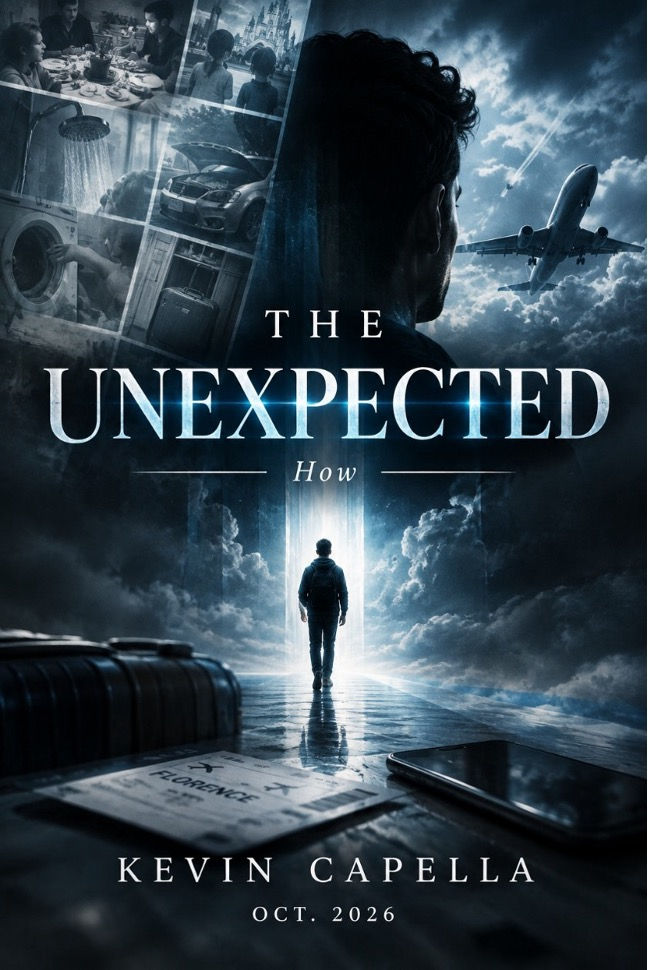
That was the happiest Thanksgiving I ever celebrated. My whole family was united as we ate the stuffed turkey, accompanied by the classic rice that my mom made every year. My uncle had made the delicious pumpkin pie, using pumpkins from his neighbor Olivia’s farm. My grandparents smiled as they watched everyone in the family eat and talk about the nostalgic 2010 trip to Disney World. We laughed, remembering how embarrassed my grandfather was after the lady from the restaurant made him ride the horse and scream while we sang happy birthday to him.
My brother, 42, had the happiest expression I’ve ever seen on him. He was always a quiet, expressionless person. Still, I knew he had many emotions inside him. I knew his love for our family went beyond infinity. He would do anything in his power to protect us, and he always made sure we were all in a happy place.
I remember when, thirty years ago, my parents had no money to buy us both Christmas gifts. He would arrive soaked and very late from school. I discovered recently that he went to the streetlight to ask for money. He did this to buy himself a gift to put under the tree so that I wouldn’t feel guilty about having the gift I wanted.
It has been 134 days since he died, and I haven’t seen my family since the day of the funeral. His death just changed everything; we don’t meet anymore on weekends to talk about our memories together. He specifically decided to give me the house, and I’ve been living in it ever since. I think that is the reason why I am still so affected by his death.
Because of this, I planned a trip to Florencia. When I planned this trip, I had in mind the goal of freeing my mind from his memory. I am going alone too, as fear of seeing my family again will make me relive his absence even more.
I woke up that morning at 8:00 a.m. and immediately opened my closet to look for my suitcase. I knew it was there, but somehow, it wasn’t. My plane was leaving at 2:00 p.m.
I felt happy for the first time in many months. As usual, I looked at myself in the mirror and saw the crazy-looking hair that I woke up with every morning. I got in the shower, but no water came out. This was normal for me, as there had been water issues in the whole country for the past three years. Then, I went to the laundry inside my brother’s house to look for the clothes I was going to take on the trip, but somehow, the washing machine was turned off, and the clothes were never washed. I remember pressing the power button for the cycle to begin.
I then had to dress in some clothes I had hanging by my bed frame. I walked to my car, which was in the garden, and saw the neighbor. He told me that he had water, so I concluded that the water outage issue was only in my house. As soon as I started my car, I heard a loud “boom.” My engine somehow exploded. I didn’t understand why this happened, as the car was only two years old. I thought about cancelling the trip, but then I remembered the reason why I was leaving in the first place. I probably couldn’t have survived another day in that house with my brother’s memory in my mind.
I had to go buy a new suitcase at a Walmart that was 5 minutes away from my house so I decided to walk. There was one thing I was sure of: I was not going to miss that flight because of these mysterious circumstances. I left my house with only my phone, and when I entered the store, I thought, “Walmart does not have Apple Pay.” For this reason, I had to walk back again.
Everything was going wrong that day; I didn’t know what was happening. I ignored everything that was happening and got to the airport on time, after buying the suitcase and packing the clothes I needed.
I boarded the plane and the flight attendant gave me a glass of water. The plane took off, and suddenly, I recognized the sound: A loud “boom” made the plane fall about 200 feet. Everyone started screaming, even the flight attendants. Both engines exploded and stopped working. The plane then started descending quickly, gaining speed every second. We were still above land, and there was no body of water near the airport.
The breathing masks came down, and everyone —still screaming— put them on. This lasted two minutes, but for me, it felt like ten. The plane was about to crash. 243 passengers, dead.
Suddenly, while we were falling, a white light illuminated the entire plane. I thought I was in heaven already. The plane completely stopped moving, and it was still surrounded by that white light. I still felt alive.
Everyone cried, even louder. I thought we were caught by aliens or something similar. Then the doors of the plane opened as if we were on land. I stepped out of the plane and there was nothing anywhere, only white light. There was no sound, no smell, and nothing to be seen, only the confused faces of all passengers who were brave enough to get off the plane.
The floor felt rough, but when I looked down, there was no floor. I kept walking and saw a weird column that extended miles upward with images from my past. I got closer to this column, and many more columns started appearing; there were thousands. I couldn’t see anybody anymore. All these columns had memories from my past. As I wandered around them, I watched myself having Thanksgiving dinner with my family and opening the Christmas presents with my brother.
I moved closer to a specific one, and my hands could pass through it. I saw myself putting clothes in the washing machine. As soon as I touched the column, the machine turned off. I then went to the one on the right, which showed me opening the closet door with a suitcase inside. I swiped my hands through it, and the suitcase disappeared.
I understood everything at this point. I was dead.
I then walked to all nearby memories and swiped my hands through them, trying to warn my past self of what was going to happen. I made the car engine explode. I cut the house’s water source. My dumb, past self ignored it and continued with the plan. I cried.
How was I so dumb? I gave up since I had tried everything I could think of.
However, I approached the only memory I could see —I was sitting in the airport, about to board the plane. I reached through the memory and touched my past self’s shoulder. Looking so confused, I deeply stared into my own eyes and said, “Don’t board the plane.”
Then, everything turned dark.
I opened my eyes in my bedroom. My suitcase was beside my bed, and the clock marked 8:00 a.m. The plane was leaving at 2:00 p.m.
This time, though, I knew what was going to happen.
The End.
“Unrecognizable”
by Rodrigo Irizarry López

My father hated being photographed. He always offered to hold the camera, even at his own birthday parties. I thought he was shy until I found the man in our vacation pictures.
He stood behind us at the beach, wearing a wedding suit, ankle-deep in the water. In our camping photos, he watched from between the trees. At first, he was barely visible in the background. But with every photograph, he seemed closer to me, although he was still unrecognizable. I counted fourteen pictures before I noticed something worse: In each one, he had his mouth opened wider.
I showed Dad while he washed the dishes. He looked at my phone, then dropped a plate. Neither of us moved until he laughed.
“Some tourist,” my dad said.
That night, he asked twice whether I had deleted the pictures.
Instead, I searched the boxes beneath my dad’s bed and found a wedding photograph. Mom stood beside that same man in our vacation pictures. His face was clear this time. Beneath the picture, in her handwriting, were the words: “Our beginning.”
I recognized his crooked pinky in the picture; mine had the same bend.
Mom had died when I was only three, and there were no pictures of Dad before Mom died. Whenever I asked, he said grief had changed his face so much that I wouldn't recognize him anyway.
I heard his bedroom door creak. He stood there, watching me hold the photo. For once, he didn’t try to smile.
“This is my father,” I said while looking at the picture.
He nodded.
Downstairs, the big clock was ticking. It was midnight. Our house was the last on the road, beyond the town’s last streetlight. Rain was hitting the bedroom window, and thunder struck in the backyard.
From where I stood, I could see the dark hallway and the family portraits hanging along the walls. The man was smiling in every one of portraits. I waited for an explanation, something that would let me stay his child.
“I buried him in that suit,” my dad said quietly. “I wish he’d stopped wearing it.”
He stepped inside the room and closed the door.
“You weren't supposed to find that,” he said.
I backed towards the wall, still holding the only picture of my dad where he wasn’t screaming.
The End.
“Lunch”
by David De Jesús Rivera
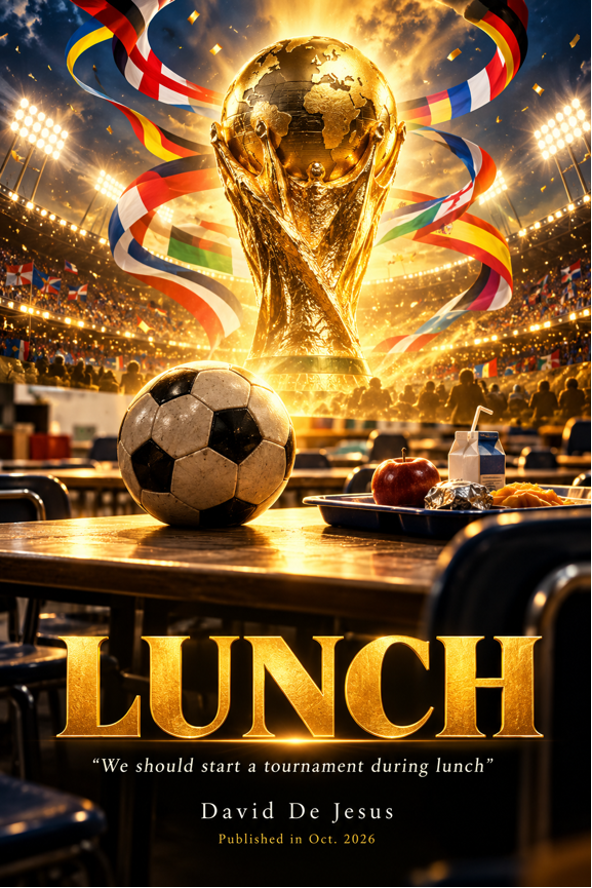
“We should start a tournament during lunch,” said Seba.
The words were simple. Almost insignificant. But the moment they left his mouth, Seba knew he had said something revolutionary.
Others quickly supported his idea.
“I can open an Instagram account,” said Dani.
“I’ll run interviews and take official photography,” said Andres.
Just like that, a plan was born.
That afternoon, what had begun as a passing thought transformed into something far greater. Messages were sent. Teams were assembled. Players were recruited from across the school.
They gathered students from many classes, and the tournament officially kicked off —merely days after its proposition.
As Sebastian spectated the first game, he realized he had created a masterpiece of an event. What had once been an empty stretch of lunch-hour space was now an arena. Cheers erupted. As the tournament developed, El Coliseo Jose Gil de la Madrid saw increased attendance day by day.
Then, came the final.
Two teams. Six victories apiece. One match to determine everything.
After a final filled with incredible scenes and moments, a team was crowned champion. Seba did not hesitate to organize the tournament's second edition.
However, days later, he received the devastating news: El Coliseo Jose Gil de la Madrid was to be demolished the following month. As the news hit the world class athletes, who were keen to participate, they found themselves feeling empty.
And so, the tournament that had risen from a single sentence came to an abrupt end.
An event whose peak was unlike any other event was condemned to wait years for its return.
The CSI World Cup no longer existed.
The End.
“Romance between Age Gaps”
by Alejandro Juan Casillas Morales

At age 33, I was sure about what a wanted in a man: a tall, strong bald guy that looked like a model. But one day, while holding a smoking saucepan, an 18-year-old boy called Daniel knocked on my apartment door.
“Can pasta catch fire?” He asked.
“Where’s the water?”
He stared into the pan and said, “I knew I forgot something.”
Over the next month, this kid and I kept running into each other —in a good way. He made me laugh, remembered things I had told him, and eventually had the courage to ask me out.
“I’m fifteen years older than you,” I reminded him.
“I’m asking you to dinner, beautiful, not challenging you to a race of any type.”
I agreed and told him I will have dinner with him.
At the restaurant, he wore a different style of what I was expecting. He put on some jorks and a crop t-shirt, something I never imagined someone was going to wear on a first date.
“How nice,” the waiter said. “Dinner with your son!”
Daniel lowered his menu and looked him in the eye. “Actually, it’s a date. But thanks for making the appetizer uncomfortable.”
I laughed, but my face burned. For the rest of dinner, I noticed every weird glance normal couples took at our table. Daniel kept talking to me, but I was barely listening.
After dinner, when we were walking outside the restaurant, I stopped him.
“Maybe this was a mistake. We are at different stages of life, and everyone seems to notice.”
His smile disappeared.
“Does the age difference bother you, or are you more worried about the waiter and what other people think?”
I opened my mouth, then closed it. An hour earlier, I had been enjoying myself. Now I was letting a stranger decide whether or not we had a second date.
“Both,” I admitted. “But I like to get to know you better. Slowly.”
“I can do slowly,” he said. “You saw how long it took me to cook pasta.”
The next Saturday, we made dinner together at my apartment. This time, he filled the pot with water before turning on the stove.
“Look at that,” I said. “You are learning fast.”
After dinner, Daniel helped me wash the dishes. He used so much soap that the sink looked like a bubble bath, but at least nothing caught fire.
At the door, he smiled. “So, did I earn the third date?”
“Possibly, but you’re still banned from using the stove unsupervised.”
He laughed, and I leaned in to give him a quick kiss, but when I pulled away, he was shocked.
“What?” I asked.
“Nothing. I’m just glad I burned that pasta.”
“Don’t get sentimental, Daniel. You still owe me a saucepan.”
The End.

“The Golden Valve”
by Alejandro Jiménez

Another day where my daughter, Valeria, and I follow our tradition: buying coffee before dropping her at school. Only this time, I faced a harsh truth that I couldn’t afford to do this anymore when the barista, Marisol, said to me that the credit card had been declined.
“Thank God that Valeria is sitting at the table!” I said that to the barista, and since we have been buying coffee from that same place for over a year, she gave me a break and said that they were on the house. We proceeded to follow our routine as it was.
Valeria then asked me if I could give her 10 dollars to buy lunch during the school trip. I said, “Of course, anytime.”
So I handed her the money while the AC of the pickup truck didn’t work, and I was already sweating. That was my lunch for today, but of course, I did not tell her that. After dropping her off, I received a job call from Mr. Sánchez to go to his house and fix the bathroom sink that was clogging up. Mr. Sánchez was one of my wealthiest clients, and he lived in a 2-story MANSION in Dorado. He lived well!
Rain was hitting the windshield as the truck traversed through Highway 22, and it kept making strange noises —on top of all the sweat I had accumulated. I was praying during the ride that Mr. Sánchez would pay me, as I saw various papers of unpaid bills in the cupholder, and I would have to lie when Valeria asks me about them. The LUMA bill, monthly rent, and credit card bill were amongst the ones I kept from her. I didn’t want her to worry about my financial struggles.
As I entered the driveway, all I saw from the windshield were the Rolls Royce and the Lamborghini surrounded by this giant palace.
It made me feel more insecure as my hands smelled like metal and pipe sealant and my truck was barely holding on but then remembered that Mr. Sánchez always treats me very nicely, so I proceeded to knock on the massive door.
The huge crystal chandelier, the stairs curving their way to the second floor, the clean marble floor, and the panoramic view of his swimming pool were all enveloping me once Mr. Sánchez welcomed me in. His mood was at an all-time high; he wanted to show me around his house. It seemed like he wanted the company. I didn’t think much of it until I saw that every photo portrait was just him; it appeared like the other people in the pictures were all cut out. That was weird.
Then, he stopped to talk to me about his very picturesque painting of the impact Van Gogh had on his life trajectory. “It’s the only thing in this house that has never asked me for anything.”
Honestly, I was just thinking about how unnecessary it is to spend money on art because it doesn’t bring any value to my life. I instantly said in my head: “These people don’t understand what’s it like to have your card declined even when buying coffee.”
Mr. Sánchez showed me the issue he had —the reason he had called me. The granite sink beside the automatic toilet had clogged up.
Nothing seemed out of the usual at first. When I opened the cabinet below the bathroom sink, the pipe system was intact. No leaks, no broken things. For me, it’s common that I first find the root cause, but this time, it was different. It required me to lay down under the pipes and use my flashlight and pipe wrench. I started twisting and unscrewing the pipes and noticed something odd.
There was a pure golden gate valve that stood out amongst the regular white pipes. I started admiring it for 5 minutes because if it was solid gold, then it must be very expensive. In awe, I was analyzing every aspect of this valve when suddenly, it hit me: This is broken, and it does not let the water pass after that point. A new idea came to my mind, though.
“If I take this to replace it with a regular and new gate valve, then I could maybe sell it to fix my car. He won’t notice it.”
I met again with Mr. Sanchez in the primary bedroom that was bigger than my house. The walk-in closet could have been mistaken for a retail store; the bed could’ve comfortably fit a seven-foot-tall person; and the television was the size of a billboard. I was thinking about all this wealth while Mr. Sanchez was thanking and praising me for always fixing his plumbing problems efficiently.
So, I left to buy him the new gate valve at the store while hiding the old one in my equipment bag. Once I confirmed he was not paying attention at me getting in my car, I took it out to admire it under the bright sun, placing it on top of the pickup truck. After that, the truck made the strangest noise ever; I assumed that I was going to be walking back.
I started up the truck expecting the worst, but I was completely wrong. It fired up like it had a brand-new engine, and on top of that, the AC worked!!!! It was getting cold here. I thought that it was purely good luck until after I started driving that the golden valve, laying on top of my wallet in the cupholder, suddenly leaped onto the car floor as if something tossed it. My wallet was looking fuller, so I picked it up and noticed it was full of cash. “WHAT THE!!!”
Behind the bills, in the plastic sleeve where I keep Valeria’s school picture, her smile looked a little paler, like a photo left too long in the sun. I didn’t think anything of it. The next morning, I paid in cash and left a bigger tip than the prize of the coffee. For the first time in weeks, I didn’t check my balance before ordering.
Marisol, the barista, took the bills without looking up. “First time here?” She asked.
I laughed, “very funny.”
She didn’t laugh and handed me the receipt with the same polite smile she gave tourists.
She’s tired, I told myself. Everybody has bad mornings.
That afternoon, I climbed onto the roof where the leak dripped into Valeria’s room every time it rained. I pressed the valve against the cracked concrete. It hummed, and the crack sealed itself like a healing cut. I did the same with the generator, washing machine, and front door. Everything the valve touched came back to life.
When I came down for water, I noticed the drawing on the fridge, the one Valeria made in third grade of the two of us holding coffee cups. The paper was blank. Only the magnet remained.
The humidity, I thought.
That night, I spread every bill across the kitchen table: LUMA, the truck loan, the credit card, the rent. I had lied to Valeria about every single one of them.
One touch —that was all it took. The red letters faded, and one word appeared on every page: PAID.
I slept better than I had in a year.
The next morning, I parked in our usual spot at the café. Valeria didn’t move.
“Why are we stopping here?” she asked.
“For coffee,” I said. “Like always.”
She looked at me the way Marisol had. “Since when did we get coffee before school?”
I waited for her to laugh, she didn’t.
“Every morning, Vale, for a year. You always order the caramel one and complain that it’s too hot.”
“Papi, I don’t even like coffee. Can we go? I’m going to be late.”
My hands shook on the steering wheel. In the cupholder, the bills sat in a neat stack, every one stamped PAID. Next to them, the golden valve was shining more than usual, as if it were proud of itself.
I drove her to school without saying a word. She waved goodbye like I was any other dad.
The rain had started again when I reached Dorado. I didn’t knock. I walked past the chandelier and the marble floors until I found Mr. Sanchez standing in front of the Van Gogh.
I held up the valve and asked him, “What is this?”
He didn’t look surprised. He looked tired. “I wondered how long it would take you.”
I looked at the photographs again, at the empty spaces beside him. They hadn’t been cut out. They had been erased.
“Who were they?”
“My wife Carmen. My son, Andrés. My brother.” He touched the nearest frame. “Every time I fixed something, I lost a little more of them.”
“Then why did you call me?”
“I jammed it shut, I tried to throw away the valve, but it always came back.” He finally looked at me and said, “I knew you would take it. I hoped you would.”
I wanted to yell at him but couldn’t. He had spent months alone in a palace, waiting for anyone to walk through the door.
He nodded at the painting. “You thought this was a waste of money. Maybe it is. But it’s the only thing I have that did not come from the valve. That’s why it’s worth something.”
Finally, I understood. The valve could fix anything that had a price. It just took away the things that didn’t.
I went back to the bathroom and screwed the golden valve back into place.
Outside, the truck coughed when I turned the key, and the AC blew hot air. My wallet was empty except for Valeria’s picture. Her smile looked normal again, but I knew her memories of us weren’t coming back.
The next morning, I took Valeria to the café anyway. When I handed Marisol my card, it declined.
This time, I laughed.
Marisol looked at us for a moment, then smiled: “Don’t worry about it. These are on the house.”
“Vale, want to start a tradition?”
She rolled her eyes at me, but she sat down with her caramel macchiato.
The End.


“Sweet & Salty”
by Andrés González Betancourt

Adolius’s signature “Carrot & Caramel Cake” dish had officially sold out at Sweet & Salty – this had happened for the last 665 days. Even after 20 years in Babylon, not one chef had come close to the taste of his cake, or at least, no chef in Merkes District.
Every night by nine, the cakes were gone. People said the cake was famous only because it was expensive, that in Babylon a thing becomes delicious the moment ordinary people can no longer afford it. Those people never tasted it. I have, and the price had nothing to do with it.
Adolius knew who sat at his tables: magistrates with rings on every finger, merchants with more ships than they could name, ministers who sealed crooked deals over a slice of his cake. He told himself a chef’s job was to feed people, not to judge them. He wore gold-threaded coats, drank wine he did not like with men he liked even less, and waited for the success that would finally feel like enough. It never came.
The only cook who could keep up with him was Sophrosyne, though I was never convinced she was trying. She came from a banking family that owned half of Kadingirra. She ate bread and lentils every day and dropped her spare wages into a clay jar beneath her station. She also had a habit I only discovered years later: For the corrupt tables, she cooked with less effort. Not badly – she simply left herself out of it. I always thought it was a petty kind of rebellion.
Adolius was not born in Babylon. At eight, he was adopted by a couple in a farming village to the south. His mother, Oizys, set out his bowl at supper and then turned her back, as if looking at him too long might oblige her to do something. His father, Tantalus, made no secret of Calypso, the woman he truly loved. On nights with no supper, Adolius slipped into the neighbor’s garden, pulled carrots from the rows along the fence, and dragged them through sugar melted in a dented pan. His teacher, Elpis, was the first to taste them.
“Whoever made this,” she said, “knows what it means to want something.”
When Adolius left for Babylon at sixteen, Tantalus did not look up, and Oizys opened her mouth and closed it again. It was Elpis who walked him to the road.
On the 665th night since his restaurant’s opening, Adolius served the cake to the minister of canals and overheard him selling the water of the southern villages, where he grew up, to a builder who laughed at the farmers, who would simply have to move. Adolius smiled, wished them a pleasant evening, and returned to the kitchen with his hands shaking.
He had not eaten a real meal in two days. Halfway through the next order, the floor tilted, and he found himself against the cold tiles beneath the pastry station.
Sophrosyne knelt beside him and offered to send for a physician. Adolius shook his head. Instead, he reached up, broke a corner off the cake meant for the minister, and ate it there on the floor. It did not taste like Babylon. It tasted like reeds and canal water, stolen sugar, and a dented pan. It tasted like Elpis closing her eyes.
For twenty years, he had believed he was cooking to escape that hungry boy. In one bite, he understood that the boy had made every cake he had ever sold, and that he had been feeding them to the very people who kept boys like him hungry.
The next morning, a sign hung on the door: Closed for One Month.
Adolius rode south. At his old house, Oizys lifted a hand to the window, then let it fall; the door never opened, and he did not knock. He found Elpis still teaching behind the temple, and she told him about the hungry children in her lessons and the orphanage that could barely hold up its roof. She did not ask him for anything. She never had.
When Sweet & Salty reopened, its prices were ones any dockworker could afford, and the chalkboard by the door read: “Everyone eats here.” Most of the wealthy never returned. Twenty percent of every coin went to the Orange Foundation, named for the carrots in that neighbor’s garden, which funded orphanages from Merkes to the southern villages.
Four afternoons a week, Adolius taught classes himself: how to look someone in the eye, how to tell the truth when it costs you something, and, hardest of all, how to ask for help – the lesson he was still learning. Sophrosyne finally emptied her clay jar to buy three ovens for the Foundation’s school. I will admit, grudgingly, that it was generous.
I know all this because, three weeks after the reopening, Adolius caught a nine-year-old prying at his back door for bread. He did not call the guard. He went inside and came back with a slice of cake. That boy was me, Admetus, the Orange Foundation’s first child, and I spent the next ten years by his side.
The cake still sells out every night. We just stopped counting the days and started counting the children who have eaten it.

The End.
“The Box and the Alien”
by Mauro Morales Acosta

If you’re reading this, I am dead, and yes, I am an alien. I’m writing this to explain myself and to hopefully provide a type of closure.
In the summer of 2016, I came to Earth. I didn't know how.
I woke up in a small town, in the middle of a field, naked. The corn was all around me and a single box lying beside me. It was dark metal and seamless, with no hinge, no keyhole.
For ten years I lived in the shadows. I learned English from the radio and observing daily lives from the windows of houses I had no business standing outside. I studied the human race the way you might study a fire: fascinated, and careful of hurting yourself. They are a strange species. They make churches and cures, they believe in a God in which they have no way of proving his existence, and then they turn on one another, slowly, patiently, as if they had all the time in the world.
I spent those years asking the same questions. Was I sent? Was I lost? Who erased my memory, and why did they leave the box?
The box had never opened. I had tried everything, and it had answered nothing.
Until one day…
It was October 4th, 2026, exactly ten years to the hour. And the box started humming.
The humming continued, louder and louder until the walls of my small cabin shook with it. I placed my hands flat against the metal and felt the seam I had searched for a thousand times. A thin line of light appeared across the top, slow and patient.
The box started levitating, and it opened without a sound.
Inside there was a ring. Its light pulsed like a heartbeat. I figured, why not put it on, so I did. When I put it on, the memories came all at once.
I remembered the screams, a planet that had seen better days. I remembered my people, the last of them, gathered in a dim hall, and the council's voices telling me what I was. My species had been slowly consumed by a plague. Generation by generation, our population diminished, and the ones who remained lost all hope. But we were close enough to this planet's people that our biology could still restore hope. A child, born of both, would carry what we were into a future we knew we would never see.
I was a piece, a part of something much bigger, sent across the galaxy to find a home for the next generation. My memory was erased so that I could live as one of them, learn their ways, and choose someone to love, so that it would come naturally and purely.
For ten years, I believed I was a stranger with no purpose.
The ring glowed warmer on my finger, and I understood the last thing the council had left for me: The box would open only when I was ready and not when the ten years were up, but when I had learned what we never could from so far away.
I thought of the woman at the diner —your mother— who always remembered my order, the one who laughed at my jokes, asked me how I was doing, and never once asked where I came from. I thought of how, in ten years of watching, she was the only person I had never been able to study from a distance.
Shortly after that, I had you —my greatest accomplishment. I wrote this only for your eyes, and it’s crucial that you maintain that. I told your mother that once you were ready, you would receive this letter, in case of an untimely death.
Under my bed, I left the box with the ring inside it. Once you put it on, you will be able to begin contact with my home and report our findings. Only my offsprings are capable of beginning contact; that’s why I hadn’t done it. I know this isn’t easy for you to understand, I know I wasn’t there for the majority of your life, but you must understand because the fate of our race is in your hands.
The End.

“Crown & Service”
by Andrés Y. García Colón
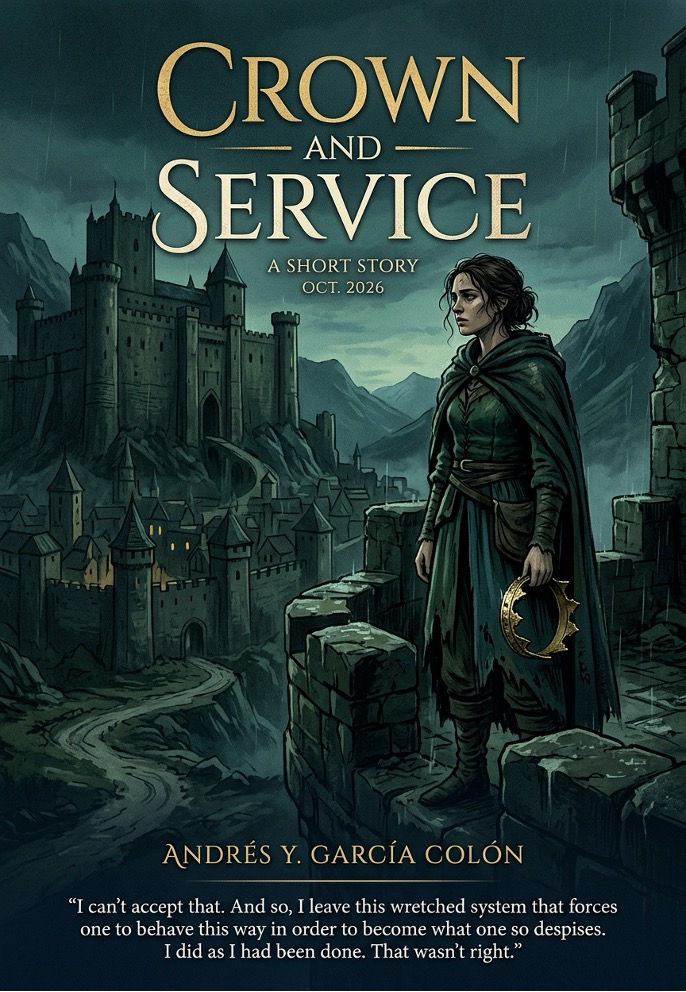
They came at night. I was sleeping. Awakened by the sound of my door opening, I felt a cold hand holding a towel around my face. I passed out. The next second, I felt a bag around my head; darkness was the only thing I could see.
I heard voices around me, they screamed and cried. I was on the verge of tears myself. That suddenly stopped when my body jumped and fell down again as if the vehicle I was in took a speed bump.
A voice started screaming "Get me out of here! Where am I!? Please, I don't want to die!"
I started sobbing, and a wave of despair took over my body "How is it I'm going to die now? It's too… What about my dreams?"
The next moments would very much define the questions posed before me. A noxious air filled the room, and I passed out.
"You are all here for 40th The Annual Grading Ceremony."
Awoken was I by the words that came from a speaker. Where am I? There are a lot of people here, all of them are near my age. Wait, that's Victor, and Lauren too. Why are we all here?
"The purpose of your stay is to complete the maze on which your future will depend on. Your parents have gone through this process too; you've never heard of it due to the secrecy we hold on the matter."
Why didn't I hear about this from my parents? Surely, they could have warned me about it.
"At three, go to the park beyond the metal doors."
The room was grey with dust and fear: triple bunk beds all around us, concrete walls, no windows, no clocks, an eerie pair of metal doors and the speaker above them that hummed statically even though it seemed to be off.
Victor went to me first, hands shaking.
Lauren was behind him. “What is this?” she asked.
Victor remained silent and seemed horrified.
I said, “Let’s stick together. I have no idea what will happen, but we should stick together in case anything goes wrong.”
"Nobody gets left behind," Lauren added.
"Promise." I replied, as Victor nodded his head in agreement, seemingly too scared to say a word.
We all promised. Words are free when you're scared.
At three, the doors opened —a park with overgrown, seemingly natural grass, a sun that shined a little too bright. At the far end, stood a stone wall taller than any building, with a single archway. It was decorated with sculptures of babies, youngsters, adults, and old people —seemingly symbolizing the cycle of life. The speaker yelled one word.
“Begin.”
The first hours were easy. That should have warned me.
On the way we met Dante, a tall person who seemed to be happy to help and eager to join our group, and Ruby, a slim girl that seemed as eager as Dante to join our group.
Dante noticed the moss only grew on one side of the walls. Ruby remembered every turn. Victor joked to keep Lauren from crying, and I laughed in a time and place where laughing felt illegal. For a while, I forgot to be afraid.
Then we reached a blocked, circular room. Vines filled the walls in all 360 degrees, with a heavy door and a button that had to be pressed down. A giant sign above the button had engraved:
One must hold. The rest may pass.
"I'll do it," I said. I don't know why, but maybe because I believed in the promise. "Find a way to open it from the other side."
"Okay, we’ll do it," Victor said. They went through one by one; Victor was last.
My arm burned. Ten minutes. Twenty. Then Victor's voice —quiet and ashamed— came through the metal.
"I'm sorry, Cami. The gate ahead only fits a few. Everyone's looking out for themselves in here. You'd have done the same."
Would I have? I let go of the button. There was nothing left to hold. I sat down against the wall. I started crying, how could they have just left like that? We... promised. As I leaned against the wall, I felt a soft spot.
I fell through a hatch, built for a worker and not a contestant. It dropped me into a white hallway. One wall was glass, and behind it, hundreds of screens showed the maze from above: tiny dots running, numbers beside each. Below them, a plaque with two columns.
CROWN was short. SERVICE went on and on.
Those who exit ascend. Those who do not shall serve.
It wasn't a test. It was a sorting. And at the bottom of the Service column, in small letters, was a name I knew better than my own.
Marisol Vega. My mother.
Every morning she left before sunrise with hands that smelled of bleach. I thought that was what grown-up life looked like. My parents never warned me because they couldn't, or because they were ashamed.
I wiped my face. I would not spend my life staring at the floor. Ninety-nine in a hundred wouldn't make it. This is the system’s design. It was the point.
I decided. And yes, I knew who I would turn into.
I used the worker tunnels to get to the end. I found Dante at a wall, hunting for a pattern. His face softened. "Cami!”
"Take the left corridor," I said. "It leads to the exit."
It led to a dead end. I'd seen it on the screens. I listened to him run and felt nothing.
Ruby was smarter, so I didn't lie to her. I simply let her walk into a room where a door would close.
Then Lauren and Victor were at the last gate, so close to the end. It was sliding shut with room for one more. Lauren reached for me. "Camila, please..."
I looked at Victor. He understood.
I stepped through. The gate closed behind me.
Everyone's looking out for themselves.
They called us Crown: fourteen out of two hundred, a glass tower, clothes I couldn't have imagined, a pin for my collar. People bowed when I passed. For three weeks, I told myself it was worth it.
On the twenty-second morning, a girl in grey set down my breakfast with her eyes on the floor and her hands shaking. It was Lauren.
"Good morning, Miss." Nothing else. Not my name, not anything. She waited to be dismissed the way my mother had waited her whole life. That was worse than screaming.
I saw them everywhere: Ruby at the windows, Dante carrying luggage with a blank face, and Victor never looked up at all.
Nobody forced me. That was the part I couldn't stand. They ask you at sixteen to choose who you'll be forever. They never tell you what or who it will cost. I blamed the maze, the people who built it. But the face in the mirror wasn't the system's; it was mine.
I left at night —the same way they had taken me. I left the pin on the pillow. The guards didn't stop me. Nobody in the Crown had ever wanted to leave, past the tower, past the wall, past the park.
I passed the Service quarters. In one of them, my mother sat awake with her head in her hands. I kept walking; she wouldn't have wanted me to stop.
Beyond the last streetlight, there was only dirt and dark. No columns, no pins. There was only a road, and nobody was telling me what I was.
The maze taught me that for me to win, someone else must lose.
I can’t accept that. And so, I leave this wretched system that forces one to behave this way in order to become what one so despises. I did as I had been done. That wasn’t right.
Somewhere behind me, a speaker hummed.
I didn't turn around.

The End.


Comentarios