
Short Fiction (Part 2)

“A Nameless Knight”
by Carlos Fortuño Ortiz

A fallen knight emerged from the ruins and bodies of the War for Athens. Dazed and confused, his mouth as dry as dust, he stared at the lifeless bodies of hundreds of soldiers dressed exactly like him. He tried to remember how he got there, even his own name, but nothing came. Not a single soul was left alive. Alone, the nameless knight set out, determined not to become one more of the dead.
As he began his journey, he saw smoke rising from a house at the foot of the tallest mountain near Athens. Carrying his heavy armour and a sword crusted with blood he couldn't remember spilling, he prepared for a long walk. Desperate to learn about his past and why he alone had risen from a pile of dead men, the knight started walking toward what might offer an explanation, a reason to live, or at least someone to talk to.
The man, exhausted from wearing his metal armour, carrying his sword, and walking for hours, was finally close to his goal. As the night suppressed the light of day, he approached the lonely, uncanny-looking house.
To his surprise, an old man, sitting on his porch, had watched the smoke of the battle all day. The old man welcomed the knight inside, where the knight saw the old man's wounded wife lying on a small bed of hay. Her arm was wrapped in a burned bandage. He fed the survivor bread and fresh meat from an animal he had butchered on his farm the day before.
Living within sight of the battlefield where the dead men lay, they knew at once that the nameless knight had come from there. At first, the old man, Lucius, pointed directly to the metal carving in the heart of his armour. He explained that the carved crest that the knight solemnly swore to defend before his memory loss was a war symbol of death that enemies feared to see. The nameless knight was tragically listening to all of the gruesome scenes that he and his group, The Sacred Ghosts of Apollo, caused to innocent, peaceful lives such as Lucius’ wife.
Lucius told him the Sacred Ghosts had burned their barn last spring with his wife still inside. The nameless knight fell to his knees, and tears ran down his face, one for every life he had taken. Lucius taught him about the cruelties of this world and how they are unavoidable, teaching the broken warrior about how to embrace peace by using his past to create a better present.
“You don't remember the man who did those things," Lucius told him. “That means you get to choose who you are now.”
The knight felt as if he had never heard such wisdom in his forgotten life, and he then took this memory loss, as an opportunity to restart his life as a wiser and more conscious man.
He lived with old Lucius for a while, until the old man fell sick and his last days were closer than he thought. On the last day of Lucius’ long-lasting life, the knight promised to keep his legacy alive and took his name for what the future held for him. Lucius then passed, with a peaceful face, like he was happy that finally he had raised a good man that was like the son he never had. From that day on, the nameless knight called himself Lucius.
He buried his sword beside the old man's grave as Lucius headed towards the journey of starting his life again with all the lessons that the old man had taught him. He looked to start his own family and life in a land far away from the unavoidable cruelties that this world had to offer —and keep the values and morals, that the old man had taught him, present in his new life.
The End.
“Gift”
by Samuel Reyes

Disappearing and appearing, I travel with ease where I can see, but my energy is drained where my eyes don’t reach.
Appearing in places I can see is the greatest of powers God gave me. But of course, living, breathing, and health do not compare, for these are the most sacred gifts God has given me.
I am different, living in a world with regular people. I never felt like I belonged.
Looking like a devil, blue skin, marks all over my body, sharp tail, but catholic by heart. I go out of my way, my calling, just to fit in and be like everyone else.
My powers allow me to go to the place I desire —to my comfort zone, my home, a place to be alone. I hear the insults, sense the stares, feel uncomfortable, then I leave and appear in another place. I pivot to different places trying to find God’s calling but get distraught with people’s opinions.
I have had these powers for 25 years.
“Powers? They are starting to feel like a curse.” I think to myself.
As I think, the most normal looking person tells me, “I can help you,” and without hesitation, I accept. We got in his car with his chauffer driving.
I asked him, “What is your name?”
He replied, “Charles.”
I said, “Charles, you said you could cure me, right”.
Charles says, “Cure? You do not have any disease, Kurt.”
“How do you know my name?” I was truly terrified and asked myself, “Who is this guy?”
He said to me, “You are not the only one who has powers, a gift. It will all make sense when we arrive.”
I felt safe with him, not judged, and he made me feel normal. My mind going 1000 miles per hour, I was doubtful but comforted; disoriented, but still very intrigued. I was impatient to arrive, God knows where, but I remained quiet.
After 2 hours in a quiet drive, we arrived to a gate. It appeared to be like an Urbanization Gate, but when we passed it, I couldn’t believe my eyes: the biggest mansion I have ever seen —bigger than the ones in movies, almost as big as a castle. The doors opened, and I was speechless. It’s ten times bigger than what it looks like. A bell rings, and people come out of what I thought were rooms. Charles starts giving me a tour of what I thought was his house.
Charles started, “Kurt, welcome to The School of the Gifted. All these people here are students and teachers that have powers. We help them understand their powers.”
“Everyone here has powers? But most of them look like normal people.”
“Yes, they do, but they know they are different from the rest of the world even if they look like them. They are special, gifted. So are you, Kurt. You do not need a cure; you need guidance to find your purpose.”
“You want me to be a student here? Is that what you are saying?”
Charles confirmed, “Yes, you will be in classes with the other students, but you will have two days a week where you will have one-on-one classes with me. This is for you to learn how to teach, since I want you to teach our new class called, ‘Embracing Faith.’”
I agreed in an instance and couldn’t be more excited. It felt like this is God’s calling —as if this is my purpose. But then, I stopped to think how does Charles know I have strong faith or how does he know I’m catholic.
Therefore, I asked him, “How do you know so much about me?”
He smiled then explained, “Oh Kurt, I know everything about everyone.”
I was listening to his voice in my head, but his lips weren’t moving!
“Kurt, I am a telepath, I can see people’s brain, their thoughts, and past.”
He was also a gifted person, and gratefully, I felt like I belonged.
I felt different, yet normal.
The End.
“The Voice of the Martyrs”
by Manuel Rosario

“Don’t be afraid, don’t be afraid, we are in this together.” Marching down the streets, we were screaming frantically.
We just wanted a better place to live.
Tehran, a city that used to stand for innovation, is now ruled by corrupt tainted leaders like Khamenei who starve people from their rights. We can’t live like this, for crying out loud, water cost 1.8 million rials, and groceries cost 900 million rials per month.
We can’t keep living like this.
The second day, the last day we took out to the streets, consolidated with an estimate of one million people. I looked at my wife with her burqa, a fabric that covers her whole face, and she pulled the black scarf up over her nose and mouth till I could only see her eyes. She did this so the camaras couldn’t depict her.
While we were stepping onto the roaring tarmac of Enghelab Street, my chest contracted as I glanced into the never-ending sea of defiant voices drowned out by the faint echoes of police sirens. This was not in any way a peaceful protest: fire erupting, consuming and garbage spilling onto the street. For a split second, time was paused, the noises faded, and I noticed that every single person here is here for something, some reason.
I looked for my personal reason and found it by my side —her mystical green eyes peeking through the black cloth. I tried to picture her smiling, but I realized I couldn’t remember her smile. I couldn’t remember the last time I had seen it.
Then, in a split second, the sound came back all at once. In the not so far distance, I saw a line of helmets and weapons.
My eyes shifted towards the grey can that hit the surf and rolled. White smoke emerged while my eyes burned. People started to go crazy, running into walls, into each other and falling to the floor. This stunt by the police only made the mases angrier.
“Go” I said, pulling her hands. “Go.”
She didn’t move. She tightened the cloth over her mouth and nose and said, “We came together; we leave together.”
The first shot sounded softer than I expected, like a door slamming somewhere far away.
The second shot did not.
Her hand went loose in mine. I don’t remember shouting. I only remember my fingers, shaking, finding the knot behind her head to untie the burqa. Her face started to unveil: her nose, then her mouth, and last her chin.
She looked at me and tried to say something…
“Don’t be afraid.”
The End.

“The Bench”
by Pablo Ochoa Ortiz

Every afternoon, Elias arrived at the train station before the commuters and waited until the last train had gone. He always sat on the same rusty, narrowed bench that the station had long since forgotten.
The station was seldom empty. The feathered creatures had built nests along the narrow edges near the ceiling, and their scratching waived with the metallic sounds of arriving trains. Through the tall windows, the afternoon lights displayed shadows that shifted whenever a train passed. During winter, the cold settled like an unwelcomed guest. It lingered long after the people had left.
Every few minutes, Elias looked up at the huge clock above the platform, even though he wore a watch on his left wrist. Many of the benches were recently remodeled and had this fancy, fresh smell. Elias disliked them. He preferred the old bench beneath him, with its peeling paint and cold metal.
Whenever the people came across him, they asked the same question. “Who are you waiting for?” He answered with the same enthusiasm every time. The words were never quite understood. Some people smiled politely, but others frowned and walked away. Elias never tried to correct them. There had been a time when words had come easily to him, and when his tongue had followed his thoughts without hesitating. Now, certain sounds rejected his commands.
It was nearly January, but Elias kept the same routine. He came every afternoon, sitting on the same bench. He watched the trains disappear beyond the station, which made him reminisce about the past. Sometimes he thought about his youth, when his friends filled him with their laughter. Those friends had long disappeared from his life. He just had their voices stored in his memory. He remembered the Friday Bowling Nights, the noise of the pins crashing together, and the laughter afterward.
He remembers playing the piano with such mellifluous ability. His fingers had once moved across the keys with precision. There had been one person for whom he played more often than anyone else. He still remembers the way she listened. She would write songs for him, filling numerous pages with lyrics he memorized by heart. Then came the memory he never allowed himself to finish.
Metal.
Glass.
A sudden silence.
After that, the piano felt silent. So did the pages she used to fill with songs. Whatever happened that day had left him with only fragments of her: the handwriting, the melodies, and a promise he could never forget. That promise was a pipe dream.
She was no longer with him.
Then, one afternoon, a lady with a red dress, pearl white teeth, and thick-light brown hair approached him.
Elias then turned towards her and for a moment, his heart sank. His eyes widened. He recognized that face. It was someone whom he had played bowling with, long ago.
The woman reached into her coat.
“Here,” she said. “This is for you.”
She placed a small brown paper bag in his hands.
Elias stared at it.
He looked down and opened the paper bag desperately. There was a letter inside. He opened it meticulously and read the words silently. Something about the handwriting made his fingers tremble. It belonged to a time he had spent years trying not to remember.
When he looked up, the lady was gone. He thought about chasing after her but realized he shouldn’t. He stood up, and for the first time left the station before the last train had gone.
The following afternoon, the bench was empty.
The End.

“Don’t Wake Up Jack”
by Gabriel Gordillo

After repeated knocks on my front door, I went to answer it. I opened the door to nothing. The porch light buzzed over an empty doormat, and beyond it, the street was completely still. No dogs, no cars, not even wind. Every house on the block looked empty; I felt like I was the only person awake in the neighborhood. I closed the door, and immediately the knocking moved to the kitchen window.
Panic got to me. I locked myself in the bathroom and glanced at the mirror above the sink, staring at the pale, frightened look on my face. After calling my parents for the fifth time with no answer, I realized I was the closest thing to an adult in the house, and 8-year-old Jack must be terrified.
I gathered courage to unlock the bathroom door and headed towards my little brother’s room across the hall. Then, again, another knock came at the kitchen window as I approached Jack’s room.
I opened his door and saw Jack completely covered in his blanket. I assumed he was sleeping; he hadn’t moved at all during the knocking. I sat beside Jack, reached for my phone again, and tried calling my parents for the sixth time, hoping they would answer this time. No answer.
Jack’s bedside clock read 10:34pm. My parents wouldn’t be home for another two hours.
While the knocking sped up, it also started spreading throughout the house. I lay beside Jack and closed my eyes, counting the knocks. I opened my eyes, expecting Jack’s clock to show 12:30, which would mean my parents were home from the party, but it read 10:41pm.
Only seven minutes had passed. Suddenly the knocking stopped, and my mother called.
“Mom,” I whispered
“What’s up, honey… We’re heading over there in a couple of hours.”
I could barely understand her over the music.
“Mom, I’m scared. Someone keeps knocking on the door and windows of the house,” I whispered again.
“Oh baby, the kids down the street do that every year. Last week they did Mr. Rodriguez’s house. Why are you whispering?”
Since it was just a prank, I was relieved. “I don’t want to wake up Jack. He’s sleeping.”
“What are you talking about? Jack’s here with us; he decided to come at the last minute. You were in the shower when we left.”
I heard my brother laughing through the phone.
But beside me, the blanket moved.
The End.

“The Worst Day Ever”
by Diego San Miguel
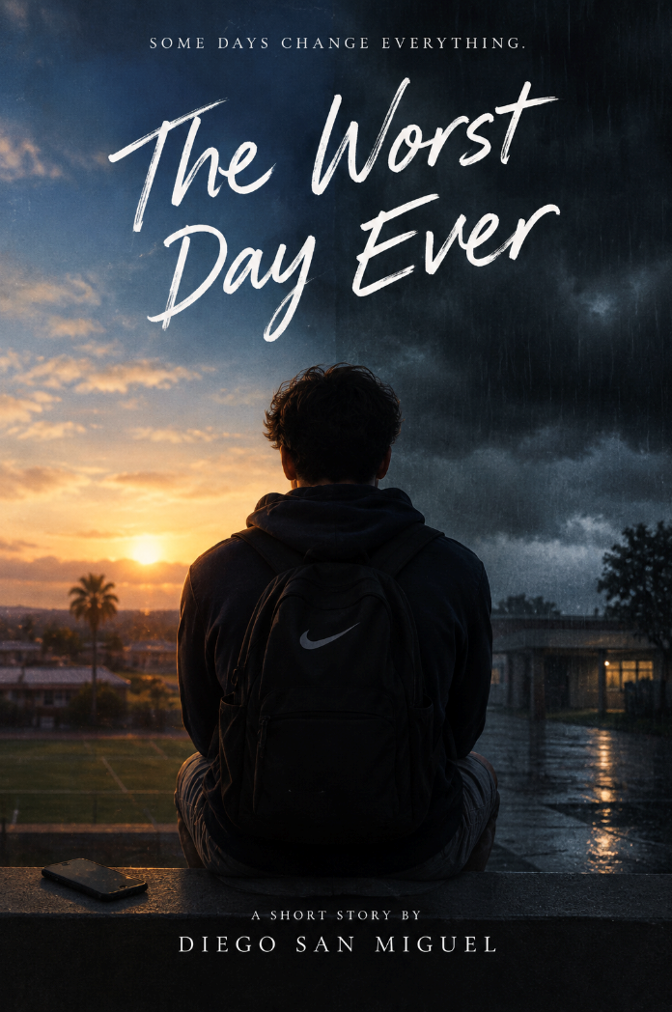
The alarm went off at 7:40am but I didn’t get to hear it. Finally, I woke up at 8:1am, and the school’s first bell rings at 8:15 at San Ignacio.
My mom was heard from a mile away, yelling at me to get up, like my life depended on it.
I checked my phone to see if my girlfriend had written to me for a good morning text, but I got a “we need to talk” text. My first impression was obviously that I messed up —which I kind of did because I had been disrespectful to her.
Next thing I know, it’s 8:16am, and I’m standing in the middle of my room, still trying to process that Adriana wanted a breakup.
My eyes watered.
I put my pants on and my mint green senior shirt, grabbed the keys, and went rushing to the car without even saying hello or goodbye to my parents.
Once I got in the car, I drove off at 103 mph to try not to get a late slip, but I knew that was inevitable.
I arrived at San Ignacio 2 minutes before first period, Calculus. I entered the room and suddenly, “there is a pop-exam of 120 points.”
The grade you get in this exam is the grade for the entire year. I’m talking about Millenium Prize Problems.
I got a 26 out of 120.
That is 22 percent in the class, and there is no coming back from that score.
Class ended, and I had recess so I go to the cafeteria. I grabbed an onion soup, went to the cashier to pay and once I paid, I walked to my table. There was a RAT!
“Anda pal …,” I yelled.
I jumped in terror, and the burning hot soup poured all over my mint green senior t-shirt.
At this moment, I just wanted to go home.
Finally, when I got home, I started to do my homework, and my dog started having a seizure.
I immediately called the vet and rushed over to see what was going on.
My dog stared at me while he was being medicated and calmed. The vet decided to put him down.
I knew this time would come, as he was 14 years old, but I never thought it would be on my “Worst Day Ever.”
“This made it even worse,” I said to the doctor.
Then, on the way home I started crying, sobbing intensely as I thought this would last forever.
Lying on the bed I realized, “One bad day does not decide your future” (although I had quite literal the worst day ever).
Adriana broke up with me, and the next thing I know, she was with a guy named Seba at her house —only a few hours after we had dealt with our situation.
I’m horrible with relationships but always looking for one.
As I went to sleep, I prayed to Jesus for a better day and to persevere in the hardest moments. I also prayed for my physical, emotional, and psychological state to remain healthy, as I knew that better days would come.
The End.

“Aliens”
by Juan Carlos Méndez

“Mission control, this is Carlos reporting from within the shuttle.” I relay through my headset.
“The current recorded time is 11:35 pm. As we prepare for launch, our ETA is 1 hour and 10 minutes.” As I say this, I realize the gravity of my situation…
In 1 hour and 10 minutes, I will have left everything I know behind to explore an uncharted territory on the outskirts of the galaxy. Many would consider a once-in-a-lifetime opportunity to leave Earth, as it decays under pollution and tyrannical governments.
While I report our current data and location to Mission Control, our shuttle lifts off the launchpad in Cuba. What I see when I look outside my spaceship’s window is a wonder. As my parents and I depart on our intergalactic journey, through the atmosphere all the way into outer space is a dark sky full of stars in the distance —a view I had only heard about in stories and descriptions by my parents since Papi has always said I'm not allowed to leave the apartment at night because it's dangerous for “un chamaquito como tú.”
The nostalgia in their faces as they described a starry night in old Havana always darkened my mood. Sadness hits as I could tell how much they missed their childhood place. Mami remarked how the crowded and lit up streets of Havana now obstructed the night’s spectacle.
Within the shuttle, the pilot is in charge of maintaining the course. I am a mission specialist so I have no specific tasks until we reach our destination. When our spaceship lands on unknown territory, I can see artificial lights twinkling in the distance, an indication that there is intelligent life on this planet.
Life on this new planet appears advanced as well as ours, with a protocol for astronauts from far away planets. As we unload from the shuttle, there are creatures with similar features and physical characteristics, yet they speak a foreign/alien tongue. When we pass through the alien checkpoint, I see Papi handing some documents to one of the “not-so-humans,” and we are quickly escorted to a wide, sterile room lined with rows of other travelers, some from places I’d only heard about in stories, all waiting to be processed.
We have to show our credentials so that they allow us to live among them. Papi gets asked several questions, including where we will stay and what skills and type of work he will be performing for this community in order for him to receive a special permit. Finally, the alien official examines our IDs, its fingers hovering over each stamp, each character.
Silence stretches in the room.
I can see Papi’s face tense slightly, like he's holding his breath until the official finally nods in approval and hands the documents over. The document is a small card with Papi’s face on it, and for the split second before Papi tucks it into his pocket, the only letters I can recognize spell out “V-I-S-A” and some sort of clearance codes engraved onto it.
The procedure feels unreal as if part of some extreme intergalactic protocol. This just finalizes our situation —entering a new world not knowing if it might accept us, but aliens will certainly keep a close eye on us.
The End.
“Deleted”
by Gabriel Rodríguez

Day Eleven.
Ines Valcourt arrived at the hotel forty minutes early, the way she arrived everywhere. The lobby was dark except for the emergency lights, which gave the marble floor a yellow glow. A single clerk stood behind the desk, staring at nothing.
Outside, the Jet d'Eau was switched off for the first time in anyone's memory. The fountain that usually threw water higher than a skyscraper was only a steel pipe in the gray lake.
She took the elevator to the conference room and sat with her back to the door. She faced the window. It was the one habit she allowed herself. When she did not want a person to read her face, she looked at the water.
Ines was fifty-two and the founder of Meridian, which stored the identity records of most of the world's governments and banks. She had built it over thirty years out of patience and paperwork. She had never lost a negotiation, and she cared more about that record than about any deal she had won.
In her coat pocket was a card with a six-digit code. The code would erase Tobias Wren from every database on Earth.
She had decided this three days ago. She had not told anyone because there was no one left to tell.
The door opened at 11:50 A.M.
"You're early," Tobias said.
"I'm always early."
"I know. I came ten minutes early to beat you, and here you are." He dropped into the chair across from her and smiled. It was a good smile, quick and warm, and it had closed a hundred deals. "You look well, Ines —for the end of the world."
"You look tired."
"I haven't slept. Have you?"
"Enough."
Tobias Wren, the founder of Halcyon, was forty-nine and a man who joked when he was calculating. His company built the software that checked every identity against Meridian's records. Halcyon had a glass tower across the river and two thousand employees, most of whom had stopped coming to work.
In his jacket pocket, Tobias held a card with a six-digit code. It would erase Ines Valcourt from every record on Earth.
He had decided this two days ago and told himself it was only business. Back in his office, in a drawer he never opened, there was a folder with no name on it. It held every interview Ines had ever given, printed, and kept in order. He told himself this was only research.
"So," he said. "Shared custody?"
"Shared custody," Ines replied.
Neither of them had anything left to gain.
In eleven days, an asteroid would strike the Atlantic, and the shock would reach Geneva within the hour. The date was public and no one disputed it. Governments had dissolved into emergency committees, and then into nothing. But the system that could erase a person from every record, contract, and register was still intact.
Each of them held half of the database. Each of them wanted the other's half.
Day Nine.
By the ninth day, the city had gone quiet in a way that felt like a holiday that would never end. Trams ran twice a day. The chocolate shops on the Rue du Rhône had their shutters down, and one still had a handwritten sign: “Take what you want. Be kind.”
The last flights left from the airport in the mornings, full of people going home. Ines watched one of them cross the sky from her office window. She watched until it was gone, and then she turned back to her screen.
She had asked Tobias to a second meeting, and this time she made an offer.
"A safeguard," she said. "Right now either of us can run a removal alone. That's dangerous. I propose we change it so that every removal needs both codes."
"That's very responsible."
"It's practical. Neither of us wants the other holding the system alone."
Tobias leaned back and tapped his pen against the table. "And if I say yes?"
"Then my engineers write the change tonight."
He said yes. Then he went back to his tower and wrote a backdoor into his half of the system, so that his code alone would still work. He did it neatly and quickly, humming as he worked.
Ines had written her own backdoor before she ever made the offer. The safeguard was real on paper and empty in practice.
Each of them could still act alone, and each believed they were the only one who could.
Day Seven.
The lie about Tobias’ mother was Ines's idea, and she told it badly on purpose.
"There are records in the system I can protect," she said. "Your mother's, for example. They're still active. If you cooperate, I can make sure they stay safe."
Tobias felt something cold move through his chest. His mother had died six years ago. She had been buried in a small cemetery in France, and he had paid for the tombstone himself. Ines knew this. Everyone knew it. It had been in the papers.
"That's kind of you," he said.
"It's not kindness. It's a trade."
"Of course." He looked at her for a long moment. He could have said it was a lie. Instead, he smiled and said, "What do you want?"
Ines had never expected him to believe her. She wanted to know whether he would call her out. She watched his face and saw him choose to play along, and she felt a small, sharp satisfaction. Then she felt something else, which she put away before she could name it.
That night, in the glass tower, Tobias's phone lit up on his desk. Clara.
He watched it ring until it stopped. A second later it lit up again, and he let that one ring out too.
His daughter Clara was nineteen and living in Lyon. She was probably calling to say she was coming to Geneva, or to ask him to come to her. He did not want to hear it. If he heard it, he would have to choose.
Across the river, Ines stood at her window. Her sister Odile lived in Montreal. Ines had not called her since the date of the asteroid strike was announced. Her phone was in her hand. She put it back in her pocket.
Day Five.
Marta Keller worked in Meridian's records vault. She was thirty-one, and for six years, she had checked the temperature of the servers every morning at seven. On the fifth, day she did not go in. Her father lived in outside the city, alone, and she had decided to be with him.
Before Marta left, she opened a form on her phone. It was a privacy request, the kind the erasure system had been built to honor. She asked to be removed from Meridian's employee registers. She did not want the world to remember her as the woman who guarded records until the end. If the world was ending, she wanted her last days to belong to her father.
Across the river, a Halcyon engineer named Jonas Brandt did the same. He packed one bag, filed the request, and caught the last train to his brother's house.
By the end of the day, four hundred people had done the same at each company. Both CEOs saw the numbers fall. Ines read them as a sign that Tobias was poaching her staff. Tobias read them as a sign that Ines was pressuring his. Neither one asked why people were leaving.
Day Three.
On the third night, Ines and Tobias met in the dark hotel conference room for the last time. They had run out of tricks.
"You built a backdoor," Ines said.
"You built one first."
"I know."
"I know you know." Tobias laughed, but it came out thin. "I built mine because I knew you would. You've never once done what I expected, except to be exactly what I expected."
Ines turned to the window. The lake was black. She could see a few lights on the far shore, and one boat that did not move.
"Nine years ago," she said, "when we talked about the merger. You said something in that last meeting. You said we'd be unstoppable."
"I did."
"I left because I believed you."
He stared at her. "You left because you were afraid of me?"
"I left because I wanted it too much." She did not turn around. "I thought you would take it from me. So I took it from both of us."
Neither of them said anything for a long time. In that silence, each saw the other's whole mind laid out like a chessboard.
Every trap Ines had set was one Tobias would have set. Every escape Tobias had found was one Ines had already closed. They had spent eight days trying to outmaneuver someone who understood them completely, and neither had ever had that before.
Only God knows what that silence cost. It was the last chance. One of them could have said —this is foolish; let's go home. Both thought about it, but neither of them said anything.
"Tomorrow, then," Tobias said.
"Tomorrow."
Day One.
The power had failed in most of the city by morning. Ines sat at her terminal in the Meridian vault, lit by the glow of the screen and the green lights of the servers. Across the river, Tobias sat at his in Halcyon’s glass tower, with a gray sky filling the window behind him.
Each of them had typed the other's name. Each of them had the six digits ready.
Ines thought about the hotel room and the lake, and about Tobias saying unstoppable.
She also thought —If I am the one who stays, then I was right to wait. She pictured the empty chair across the table. She could stand it.
Tobias thought about the folder in his drawer. He also thought —If I am the one who stays, I will burn it myself.
His phone lit up on the desk, with Clara's name on the screen, and he did not look at it.
They had won nothing. In one day, the sea would rise over the coast, and the sky would burn. There was nothing left to own. But neither of them could stand to be the one who had hesitated.
Therefore, they pressed enter at the same moment.
The system processed both requests. It removed Ines Valcourt and Tobias Wren from every record, contract, share register, and directory in the world.
Each had meant to be the survivor.
Neither was.
Meridian had no founder. Halcyon had no owner. The buildings ran on their generators for a few hours and then went dark.
On both screens, one line appeared, “Record removed. No further references exist.”
The phone on Tobias's desk rang once more and stopped. A woman in Lyon put down her own phone and wondered, for a moment, who she had been trying to call.
The asteroid arrived the next day. The erasure changed nothing about that. It changed only how the last day was spent.
No one remembers Ines Valcourt or Tobias Wren. No one remembers the lake, or the folder, or the way he said unstoppable.
They gave up their last days, their families, and each other to keep the other from winning, and in the end, there was nothing left to win.
Only this telling remembers them.
The End.
“A Black Figure”
by Mauricio Arbona Nazario

I was eating breakfast, minding my own business, and getting ready for school. The day was lustrous; the house was shining from the inside. I just had an amazing weekend on an island with some of my friends —thinking today was going to be just like any other day.
The weekend was long, Monday was off, and the week is sooner for school to end. Only 4 days of classes left, and I will leave school early on Wednesday and Friday. Little did I know, I would have to miss today and Friday.
I was eating my father's magnificent French toast; my favorite breakfast in the whole wide world. How would I have known all of this would go wrong?
On my family's kitchen, both of my parents finally arrived. They started surrounding me with that face: the face that made me feel as if I was the problem. They flooded me with questions they knew the answer to —questions about suicide.
Obviously, I didn't want to do it. I was thinking, “I just had an amazing weekend!” And today was a good day, a radiant day. All of it quickly changed, just like how cellphones in the sun turn down brightness automatically.
I appeared in a hallway, and this black figure was watching me. I ignored everything my parents said to me not because I wanted to, but because something important was happening.
This dark hallway, I couldn't escape; it was as if all the other personalities I had created turned into a giant version of themselves. Who am I? Who is the real me?
I am just a 17-year-old trying to understand everything that is happening. No one told me how to deal with anything. All those bad thoughts and events I had experienced —was that the reason this figure was created? A black figure. Standing in front of me, doing nothing, just observing.
When my parents’ talk was over, the figure also disappeared. I went to my room to hear “Buddy Holly” by Weezer for no reason. I just wanted some time alone like I always do.
However, the figure would appear again in front of me, in front of my whole room. Standing between the bathroom and the bathroom door cracks, he was there, observing me closely, waiting until I finally acknowledged him.
There was no place I could run this time, just like the hallway; I was trapped. This time he was in a place I knew very well. In front of me, I saw all my collections of Funko Pops, the schoolbooks I should have in my backpack, and my computer. The figure was extending all his arms to me, and suddenly I felt the whole room getting darker and darker as microseconds passed by. I couldn't move, no matter how much I tried to.
He reached his whole hand towards me and disappeared at that exact time.
I had to leave home to go to a therapist, so he could give me the green light to be able to go back to school. I wanted to get this over as soon as possible.
It took a long way for me to reach this place, but I finally accomplished it. Each day the setting changes: One day it's a battlefield, another a forest or a burnt down forest, or a destroyed home. It seemed impossible for me to reach this place. I couldn't find the door to enter this damn hallway. It kept moving every step I took.
As if my owner didn't want me to talk to him, he banished me to this isolated place and locked me in a closet with no key —and left me to die, no water, no food, no thought.
Every place I walked to was glitching every second. Did I deserve heaven or hell?
My owner, though, told me that I deserve hell; that's why he locked me inside his intelligence: A dark mood. This was the dark side of my creator's brain —all the things he didn't talk about.
I can't do anything except torture him by chewing on his electrical cords, hunting every version he creates to escape himself. The only one time I came face to face with him was when he didn't understand the monster he had created, me, or himself.
In that “amazing” weekend, all the things he tried to hide that made him have a sinister conflict with himself finally broke free. Those thoughts suppressed from 4-8 years ago finally came firing back at him like bullets from a gun. In the end, he just stayed silent, the same reason why he stayed silent was the same reason this conflict broke out. My owner, the creator of every version of himself, didn't want me to talk to him.
I didn't trust anyone with this information, only my therapist.
I am living a life that is not mine.
Why was the figure there in the first place? Did I commit a sin so massive that God had to punish me with this figure? How, the owner of my own body, doesn't even know what's going on inside? Does this happen to everyone?
A few days went by, and I could go back to school, hang out with my friends again, and catch up on all the material I had lost. I did just that, but my friends bombarded me with questions. I had to lie to all of them: a “medical” excuse. Nobody suspected a single thing.
The End.
“POV”
by Eduardo Medina Arzuaga

I’m going to write a short story, and no, it isn’t because I want to. I have a short story project that I need to complete for my literature class, but I don’t know what to do.
Should I make something up? Should I write about something real?
I don’t know. That’s why I’m writing while I think, so you can read my creative progress. Who knows? Maybe this ends up being the short story. I might be creative in other aspects, but this isn’t really my cup of—
“Pop.”
The narrator got shot.
“I didn’t write that,” the narrator said as he stared at the sentence.
Terrified, the narrator slammed his computer shut and left his room.
Two weeks later, I finally found the courage to open this computer. The last time I opened it, the craziest thing happened to me.
I was writing a short story that I had pending (I finished it on my mom’s computer), and my computer started doing some crazy stuff that made me freak out. Now I’m just writing to see if my computer is back to normal because I can’t live without it. I’ve been contemplating trading in this computer for a newer one, so I guess this—
“Pop.”
“Oh no,” the narrator said.
“Pop.”
“Aaaaah!!!” The narrator screamed in fear.
He gasped and heard an alarm ringing incessantly.
Sweating and agitated, he just woke up from a dream and didn’t even complete his short story.
He sits up, still trying to remember what happened. After a few seconds, he laughs and tells himself that it was just a dream.
Then he looks at his computer.
It’s open —no one in front of it.
On the screen, there is only one sentence:
“The narrator just woke up from a dream.”
The End.
“Six Eggs”
by Alejandro Fernández

There were six eggs left in the refrigerator when my mother died. I knew because she had complained about the price two nights before. She came home from the supermarket, put the carton on the counter, and showed me the receipt as if I was somehow responsible.
“Six dollars,” she said.
I looked up from my phone. “For eggs?”
She nodded. “For eggs.”
I laughed. She didn’t. Two days later she was dead, and the eggs were still there.
My aunt came early the next morning. She hugged me before I could even fully open the door and held me there for longer than I expected. Her perfume stayed on my shirt afterward.
“Your mother is with God now,” she told me.
I nodded because I didn’t know what else to do.
People kept coming after that: family members I barely spoke to, neighbors I only knew from seeing them in the elevator, friends of my mother, who suddenly remembered stories about her I had never heard. They brought coffee, bread, food we didn’t need, and the same few sentences —She didn’t suffer. She’s in a better place. Everything happens for a reason.
That last one bothered me.
The police officer told me that a driver ran a red light. My mother was coming home from the supermarket when her car was hit and pushed into the concrete divider. She died almost immediately. That was the reason: A man ran a red light. I didn’t understand why people needed something beyond that.
My sister Elena arrived a few hours later. She had driven from college after my aunt called her, and she was already crying when I opened the door.
“Why didn’t you call me?” she asked.
I told her that Titi had called and said she wanted me to do it, but “I didn’t know what to say.”
Elena looked at me like the answer was obvious: “You say Mom died.”
Then she hit my chest once with her hand, not hard, and grabbed onto my shirt. I hugged her while she cried. I remember looking past her into the hallway and noticing a dead mosquito trapped inside the cover of the ceiling light. I had never noticed it before. For a few seconds I wondered how it got there, and then I remembered what was happening.
When Elena finally pulled away, she looked at me and asked if I was okay. I said yes. She told me I didn’t look okay.
“I don’t know what I’m supposed to look like,” I said. Then, she stared at me for a second, and I immediately knew I had said the wrong thing.
That afternoon my aunt asked me to write something for the funeral because my mother had always been proud of my writing. I asked what I was supposed to write.
“Something about her,” she said. “Something nice. Something meaningful.”
So I went into my room, opened my laptop, and stared at a blank document. I typed, My mother taught me— and deleted it. Then I tried, My mother always believed— and deleted that too. I sat there for almost an hour.
The problem wasn’t that my mother had never taught me anything. She had. She taught me how to cook rice because she said a grown man who couldn’t feed himself was embarrassing. She taught me not to buy the cheapest trash bags because they always ripped. She taught me that when someone said they were five minutes away, they probably hadn’t even left their home yet. But that wasn’t what people wanted me to write. They wanted something bigger —some lesson she had supposedly spent her life preparing to teach us.
My mother had been dead for less than two days, and somehow she had already become a better person. Before she died, she complained constantly. She got angry in traffic, yelled at me when I left dishes in the sink, and fell asleep during movies before denying it when I tried to turn the television off.
Now everyone talked about her as if her entire life had been leading to some final lesson we were supposed to understand after she died. That didn’t feel like her. I loved my mother. That was exactly why it felt wrong.
That night I went into the kitchen and opened the refrigerator. The eggs were still there, so were the orange juice she bought and the container of sofrito she had made the week before. I stood there until the refrigerator started beeping.
“Close it,” Elena said from behind me. She was sitting at the kitchen table. I closed the door, and she told me I was wasting electricity.
“Mom would’ve said that,” I said.
Elena laughed for maybe a second and then covered her face and started crying again.
I sat across from her. She said she hated this.
“I know.”
“No, you don’t,” Elena said. She looked at me and told me I was acting normal. “There,” she said. “You keep saying that.”
I asked what she meant. “What am I supposed to do? What am I supposed to look like? You keep acting like there’s some correct way to do this, and you just don’t know it.”
“Then why are you acting like nothing happened?”
I said I wasn’t.
She looked at me for a long time. “You haven’t cried.”
I didn’t answer.
She looked away and said, quieter this time, “I don’t understand you sometimes.”
I wanted to tell her that I didn’t understand myself either, but I didn’t.
The funeral was two days later. It was hot outside; it was the kind of heat that makes your clothes feel heavier than they are. The sky was completely clear, and for some reason that annoyed me. I think some part of me expected rain, as if the weather was supposed to recognize what had happened. Then, I realized how stupid that was. The weather didn’t know my mother had died.
The funeral home smelled like flowers and air freshener. My mother was in the front of the room in the coffin. They had done her makeup. She looked like herself if I didn’t look too closely. People kept coming up to me and telling me how proud she was of me.
One woman, I didn’t recognize, kissed me on the cheek and said, “You have to be strong for your sister.”
I nodded, but I remember wondering who was supposed to be strong for me.
During the service I couldn’t focus. The air conditioner kept turning on and off. Someone’s chair made a noise every time they moved. A baby started crying in the back. My shirt felt too tight around my neck. Everyone around me was praying, but I started counting how long it took for the air conditioner to turn on again. I lost count after forty seconds.
Elena noticed. Afterward, she asked if I had even been listening. I told her I heard something. “That’s not what I asked,” she said.
Later, I found my dad smoking outside. He and my mother had been divorced for years, and he had flown in the night before.
“I thought you had quit.”
“I did,” he answered back at me.
I pointed out that he was smoking right now and reminded him that Mom hated it. He smiled a little and said he knew that. Then, he started crying. It happened so suddenly that I looked away.
“She called me Tuesday,” he said.
I looked back at him. “What?”
“Your mom.”
“What did she want?”
He shook his head. “Nothing important.”
“What did she call for?”
“She wanted to tell me that your grandmother’s house finally sold.”
“That’s it?”
“That’s it.”
He looked down at the cigarette in his hand. “I almost didn’t answer.”
Neither of us said anything after that.
Inside the funeral home people were eating. That bothered me, too. My mother was dead, and people were standing around, drinking coffee and eating “pastelillos.” Someone laughed at a joke. Two of my cousins were talking about where they had parked. Everything continued happening around the coffin as if nothing had changed. At first, I hated them for it, but suddenly I realized I was hungry too. That felt even worse.
The next few days were strange. My aunt started going to church every morning. Elena covered the dining-room table with pictures of my mother. My dad decided one of the kitchen cabinets needed fixing and spent almost an hour working on it. I told him it was still crooked. He said he knew. I asked why he kept fixing it if it was still crooked. “Because it’s broken,” he said. That didn’t really answer my question, but I let him keep going.
My aunt had God, Elena had the pictures, and my dad had the cabinet.
I had spent the entire week thinking I was different from them because I had accepted what happened without needing anything to soften it. My mother was dead. Nothing they did changed that. No prayer brought her back. No photograph preserved her. No fixed cabinet meant anything to her now. I thought accepting that made me more honest.
Then one afternoon, I needed scissors. I opened the drawer and couldn’t find them.
“Ma, where did you put the—” I stopped before finishing the sentence.
The apartment stayed exactly the same. The refrigerator hummed behind me. Cars moved outside. Someone upstairs dropped something heavy. For one second, I had forgotten she was dead —not really forgotten.
My body had just expected her to answer. I stood there with my hand inside the drawer, waiting for something I already knew wasn’t coming. I found the scissors under some old takeout menus and sat down at the kitchen table.
I didn’t cry. I almost wanted to.
A few nights later Elena found the blank document on my laptop. She asked why I had never written about Mom. I told her I tried. “You couldn’t write one page?” she asked.
I didn’t know what to say. She told me I could have said that I loved her.
“She already knew that.”
Elena stared at me: “She’s dead.”
“I know.”
“Then what does it matter what she knew?”
She came further into the room and told me I thought I was above all of this.
“What do you mean?” I asked.
“The prayers. The funeral. The pictures. Dad fixing stuff. All of it.”
“I had never said that.”
“You don’t have to.”
I said I just didn’t understand why people pretend there was some reason for what happened to Mom. I reminded Elena that Titi kept saying God had a plan.
“You think she thinks praying is gonna bring Mom back?”
“No.” I replied.
“You think Dad thinks fixing a cabinet is gonna do anything?”
“No.” I answered again.
“Then maybe it’s not about fixing anything.”
This time, I didn’t say anything.
She sat down on the edge of the desk. “What are we supposed to do?” she asked.
I had asked the same question before, but hearing her say it made it sound different. I told her I didn’t know.
“Exactly,” she said. Then she stood. “You get to call everything fake because then you don’t have to need anything.”
“That’s not fair.”
“No.” She looked at me. “Neither is Mom being dead.”
Then she left.
That stayed with me. I had been watching everyone else and thinking they were building things around my mother’s death because they couldn’t accept it. Maybe they had accepted it. Maybe that was exactly why they needed those things.
My aunt knew prayer wouldn’t bring her back. Elena knew the pictures weren’t actually my mother. Dad knew the cabinet didn’t matter. They weren’t trying to change what happened. They were trying to live after it.
I didn’t know if that made what they were doing true. But maybe something didn’t have to be true in that way to matter.
A few days later, I opened the refrigerator and saw the eggs, again. I took the carton out and realized I had never eaten any of them. I ate everything else people brought us: sandwiches, rice, takeout, whatever was around —but not the eggs.
My aunt had God.
Elena had the pictures.
My dad had the cabinet.
And apparently, I had the eggs.
I laughed a little and took one out. I cracked it into a bowl. It was fine. Then, I took another.
The smell hit me immediately.
I dropped it into the sink. The yolk looked wrong. I turned on the water and watched it slide toward the drain, and then I started crying. It was the first time since my mother died.
I wasn’t looking at a picture of her. Nobody had said anything. I wasn’t at the funeral.
I was standing in the kitchen looking at a rotten egg, and suddenly I started thinking about everything else. Her shampoo would eventually run out. The perfume in her room would disappear. Her clothes would stop smelling like her. The food she bought would be eaten or thrown away. People would stop coming over. Eventually, people would stop asking how we were doing. One day, someone else might live in this apartment.
It felt like the world was slowly getting rid of the evidence that she had ever been here.
I sat down on the kitchen floor and cried until I didn’t anymore. After a while, I stood up and turned off the water. There were four eggs left. I took another one out. It was good.
I cooked it.
While it was in the pan, I opened my laptop. The blank document was still there, and I started writing: “My mother did not teach me the meaning of life.” I stopped for a second, then kept going, “I don’t think she knew it either.”
I wrote about how she complained about traffic. I wrote about the movies she slept through and how she yelled my name from another room only to forget what she wanted by the time I got there. I wrote about the eggs. I wrote that she could be annoying. I wrote that she was funny. I wrote that sometimes we could sit in the same room for an hour and barely say anything.
I didn’t write that she was in a better place. I didn’t write that everything happened for a reason. I didn’t write that her death taught me some lesson about appreciating life. I didn’t know any of that.
I only knew she had been here.
For the first time, that felt like enough.
Nobody ever heard what I wrote. The funeral had already happened. Elena went back to college a few days later. Dad went home. My aunt stopped coming over every morning, though she still called constantly. The apartment slowly became quiet again.
The flowers died first. We finished the food people had brought. I used the last of my mother’s sofrito one night and immediately wished I hadn’t. Her shampoo ran out a few weeks later. I left the empty bottle in the shower for days. There was no reason to keep it. I knew that and kept it anyway.
Eventually there was one egg left.
I kept avoiding it. Every morning, I opened the refrigerator and saw it sitting there.
One Sunday, I finally took it out, held it in my hand for a few seconds, and almost put it back. Instead, I cracked it.
It was still good.
I cooked it in the same pan my mother always used and sat in her chair. I had never decided not to sit there before. I just hadn’t.
I ate alone.
Nothing happened.
I didn’t suddenly understand death. I didn’t decide there was a reason my mother died. I didn’t learn what life was supposed to mean. I still didn’t know what someone was supposed to do with the fact that a person could exist one day and disappear the next.
I just ate.
Outside, people were talking in the parking lot. A dog barked somewhere nearby. Cars passed along the avenue. Someone laughed loudly enough for me to hear it through the window. The world had continued without asking whether it should.
When I finished, I looked at the empty carton. I folded it once and threw it away.
Then, I took it back out.
I stood there holding it for a few seconds. I knew it was just cardboard. I knew keeping it didn’t change anything.
I put it on top of the refrigerator anyway and thought I would throw it away eventually.
I never decided when.
The End.
“11:57 PM”
by Brandon Román

October 31st and the streets are crowded for the holiday. Kids were dressed as monsters, and witches were flooding the sidewalks. Parents were holding flashlights. The whole town was buzzing with excitement. But when midnight arrived, the streets were suddenly empty, and Quandale's phone started to ring.
It was 11:57 PM when his phone lit up, showing a number he didn't recognize. Outside, the wind was howling and blowing leaves down the empty street. A few kids made their way home from house to house, filled with Halloween candy. Quandale answered the phone anyway, curious.
"I can help you fix one mistake from your past," a voice said on the other end.
The voice was calm, and it sounded like it had been waiting for him to call for a long time. Quandale chuckled and was about to hang up.
But then, the man said he knew the name of the dog Quandale had buried in the backyard when he was nine, and the song his mother used to sing to him when he was sick, which only she had ever known.
The man called again the next night at midnight, then the night after that. Each time he asked the same question.
"What's the one thing you'd take back?" he said. The voice was gentle and patient.
When Quandale told him it was a prank, the voice said some secrets get heavier the longer you carry them around, and the only way to let go of them is to say them out loud.
Quandale wondered who the man was. Sometimes he thought it might be his dad, whom he never met and didn't even know was alive. He thought about the night he left his brother alone at the lake. He had buried that memory so deep that sometimes he could almost forget it happened. He wanted to take that moment back, but he also feared that if he did, everything else would change, even the good things that had come out of it.
He paced the floor, torn between thinking it was a real offer or thinking it was a trick that was taking advantage of his guilt.
On the third night, Quandale finally spoke.
"I don't know," he said in a voice he barely recognized.
"You will," the man said. "But you're running out of time."
Unable to sit still in the house, Quandale grabbed his jacket and took a walk to clear his head. It was foggy outside, and the pumpkins on the porches were half burned. As he reached the end of the block, a tall man wearing a long black coat passed him. Quandale was aware of him only because the air suddenly felt colder.
The man didn't say anything. A few steps ahead, the man stopped, turned his head, and looked directly at Quandale, as if they had known each other their entire lives.
Quandale ran home as fast as he could. He locked the door twice and was still gasping for air when his phone rang again. He answered.
The man's voice was calm and close, but as Quandale listened, he realized that same steady breathing he heard over the phone was coming from behind his front door. He stood in the dark hallway, his hand on the deadbolt.
If he opened the door, would it be the second chance he'd always wanted or would it take away whatever he had left?
The End.


Comentarios